Flora: The new eBPF Observability Sensor from groundcover
groundcover's eBPF observability sensor excels in cloud-native environments. Learn how it surpasses traditional monitoring with minimal resource impact.

Last Updated On: July 24, 2026
One of the hardest challenges for any modern observability tool is being able to keep up with the ever-growing scale of data - delivering a comprehensive, accurate picture of a system, all while leaving a minimal footprint. Without the right performance-first mindset, the once hidden overhead required to observe a system could suddenly become very visible and painful at high scale.
With many leading observability solutions today dramatically impacting the resource consumption of the applications they are in charge of monitoring - eventually limiting their performance or causing cost surges, engineers are more and more aware of the hidden overhead inflicted by their observability stack.
Enter eBPF Sensor – The Up and Rising Observability Sensor
eBPF has been around for a while, but in the last couple of years it has secured its place as one of the most promising, revolutionary technologies in IT.
For IT professionals, cloud-native developers, and observability teams evaluating an ebpf sensor, the core idea is straightforward: an eBPF sensor runs inside the Linux kernel to monitor system activity and gather clean data to trace kernel operations and other events in real time. It does that without changing application code. Unlike traditional monitoring tools that depend on log files and user-space agents, the data comes straight from the Linux kernel with minimal performance overhead, while still sharing statistics with user space through maps and system calls. That means you can deploy an eBPF program that watches each packet as it enters or exits the host, maps it onto processes or containers running on that host, and supports performance monitoring without application instrumentation. The result is super-granular visibility into what's happening with your network traffic, including selective telemetry that improves cloud-native network observability.
Along with that, eBPF programs are very efficient and secure, unlocking a plethora of possibilities for observability in a cloud-native world. This article introduces the basic concepts behind eBPF as an observability sensor, looks at Flora as an eBPF-based observability agent, compares benchmark results against other platforms, and examines why its low-overhead design can reduce monitoring cost at scale.
While eBPF is destined to become the next standard for observability platforms enabling low-friction integration and deep visibility coverage, existing eBPF-based approaches still have a long way to go when it comes to operating at high scale.
Introducing Flora: the future of eBPF observability in the Linux kernel is here
We set out to create an eBPF-based observability agent that applies the core eBPF model inside the Linux kernel, where an ebpf sensor loads compiled programs to observe system behavior with minimal disruption.
Flora was built with a strict performance mindset - promising full observability at high scales while costing next to zero overhead, because eBPF programs run as sandboxed programs in an ebpf virtual machine in kernel space. It is based on two key ideas that allow it to operate at a massively high scale. The first, is the use of new, unorthodox eBPF concepts that unlock extremely low overhead kernel-user data transferring mechanisms. The second, is a nearly zero-copy, memory efficient pipeline which converts observations flowing from the kernel into meaningful outputs. In practice, programs are compiled into ebpf bytecode and must pass a verification process before running, with the ebpf verifier acting as the verification engine that checks safety.
These two concepts allow Flora to relieve two of the most painful inherited problems of application observability in high volume cloud-native environments. Using eBPF allows it to operate out-of-band to the applications it monitors, promising minimal impact to its resource utilization and ensures it can continue to run smoothly in the limited containerized environment it was provided. Second, the total resources it consumes is low even at massive scales, making it extremely cost-effective overall, reducing the ongoing cost burden observability teams face today. In practice, eBPF often stays under 1% CPU overhead because it is optimized just in time after the jit compiler translates programs into a machine specific instruction set.
Flora is the driving engine behind our cloud observability solution and is now generally available and can be experienced as part of our free tier offering. Teams can also use ebpf through available ebpf libraries such as BCC or the high level tracing language bpftrace, rather than only writing custom code themselves.
Putting Flora to the test
All theory aside, we rolled up our sleeves and started looking into what kind of value Flora can truly provide our users. Flora dramatically outperformed all leading observability platforms including Datadog, OpenTelemetry and New Relic’s modern eBPF solution - Pixie Labs.
The conducted benchmark simulated a high volume environment tracking a simple baseline HTTP server application for metrics of CPU and memory consumption before and after the integration of the various observability platforms in question.
Setting up the test bench
Our test application was a basic HTTP server built in Golang (v1.19) that serves a configurable number of random JSON objects, performs a pre-configured amount of CPU-intensive tasks per each request it receives, and returns its response in a Plaintext or Gzip format. All parameters were built to be configurable through the received URL parameters.
The test application was then tested in the different scenarios as is (for baseline), when instrumented according to relevant documentation of Datadog and OpenTelemetry, and when running on a Kubernetes node alongside New Relic's Pixie agent and the Flora agent. Prometheus-based CPU and memory utilization metrics were generated for all test cases, and were scraped and stored in a VictoriaMetrics database instance. Because these programs are event-driven, teams attach eBPF programs to predefined hooks in the Linux kernel, such as kernel tracepoints, trace points, system calls, or a kernel probe, to observe runtime behavior. Teams that write eBPF code typically use pseudo C code and compile pseudo C code with the LLVM compiler suite, a common compiler suite for this workflow, before they load eBPF programs.
The infrastructure was a Kubernetes cluster with Node Taints that allowed us to isolate each deployment test case from the others. Every tested application flavor ran alongside the bare minimum components required for monitoring according to the relevant test case.
To generate the test load we used a K6 operator, with K6 test objects that executed from each of the separate Node groups. We used a custom-built K6 image that also exposes Prometheus metrics so we could get metrics from client side as well for sanity purposes.
We analyzed the results in Grafana, through a Prometheus data source integration that queried the deployed VictoriaMetrics instance.
Flora lives up to its promise
First, we generated a constant load of 3000 req/s hitting our HTTP server application across the different setups. Flora demonstrated minimal to zero overhead to the application's CPU (+9%) and memory (+0%), while still capturing high-fidelity data such as per-request latency and packet analysis for better performance analysis. Flora's minimal overhead also preserves deep visibility into kernel-level activities and network packets, while Datadog, OpenTelemetry and the Pixie agent inflicted dramatic overhead of 249%, 59% and 32% above the CPU baseline, respectively, and 227%, 27% and 9% above the memory baseline.
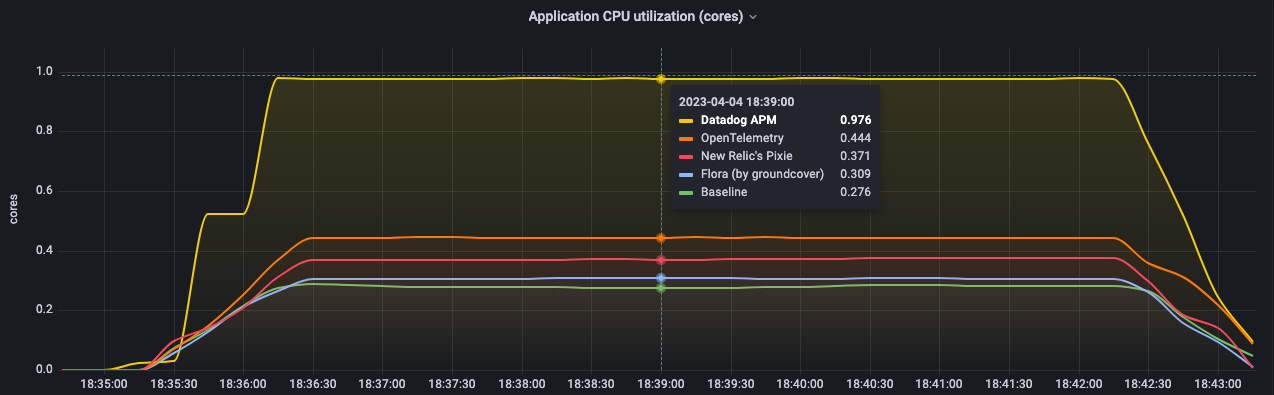
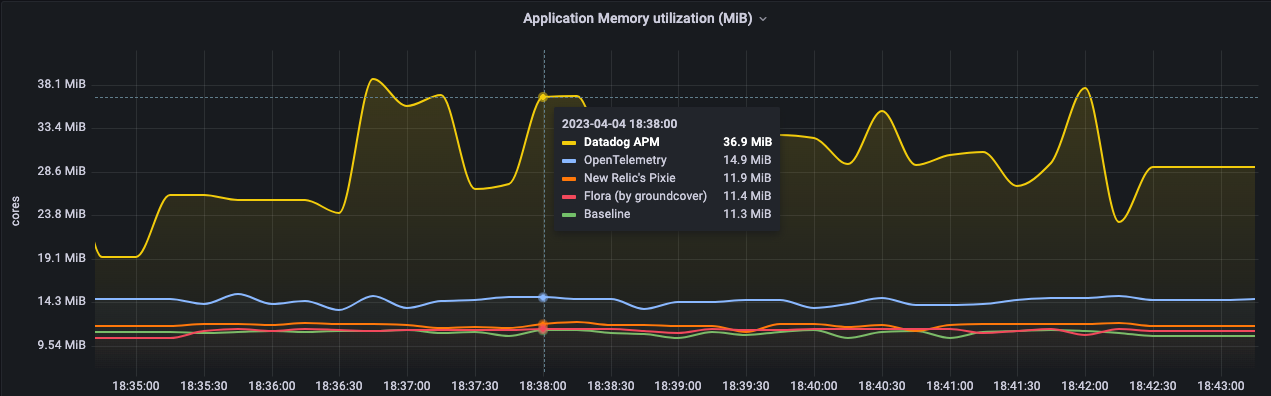
All other solutions but Flora raised the resource consumption of the application dramatically and in an unexpected manner, potentially causing the application to reach CPU throttling that might degrade its performance or even create an out of memory crash (OOM) in a limited environment.
Additionally, under a limited CPU environment for the monitored application (limiting the CPU of to a maximum of 1000mCPU), and a constant load, the overhead added by Datadog, OpenTelemetry and the Pixie agent was also demonstrated to significantly limit the bandwidth for the HTTP server, reducing the volume of handled requests by 71%, 19% and 12%, respectively, compared to the measured baseline.
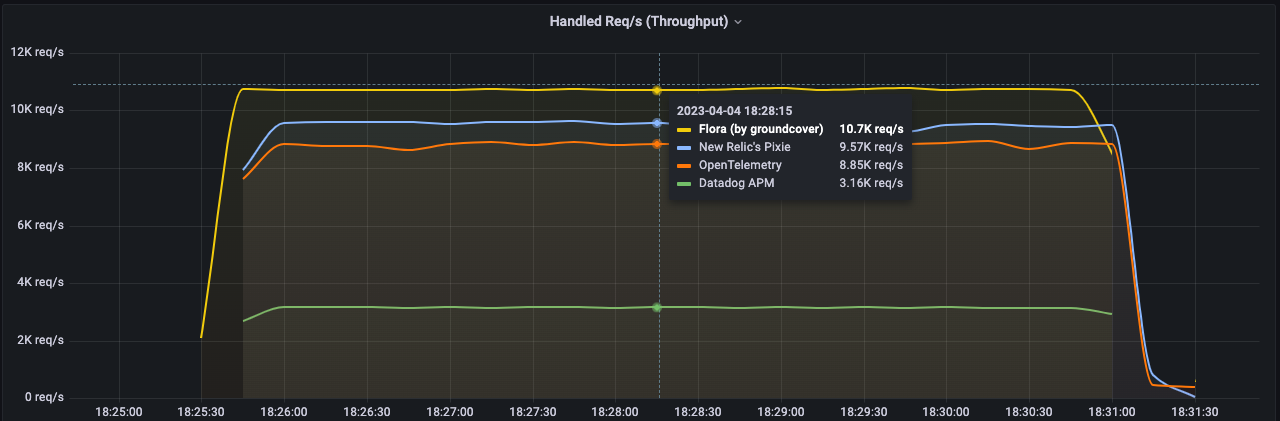
Outperforming Datadog By Over 3X in Performance Monitoring
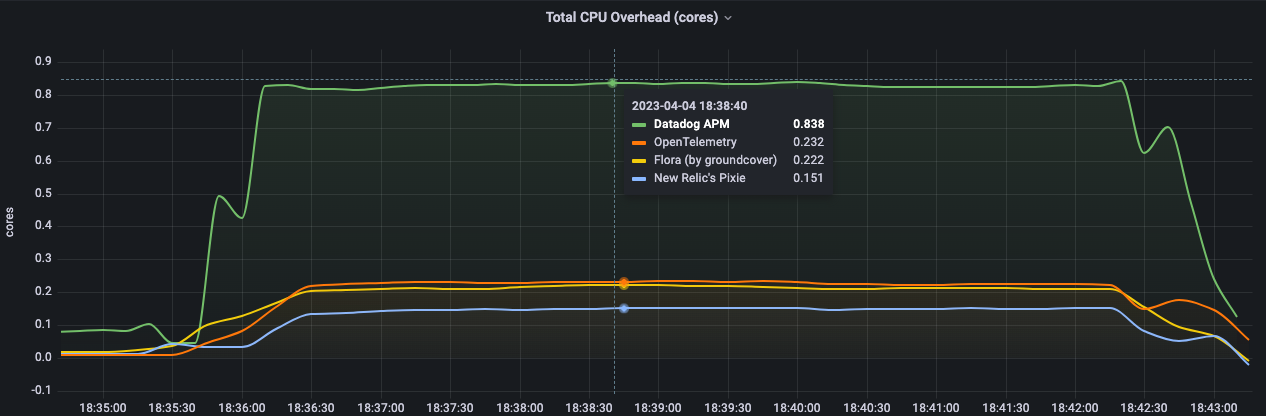
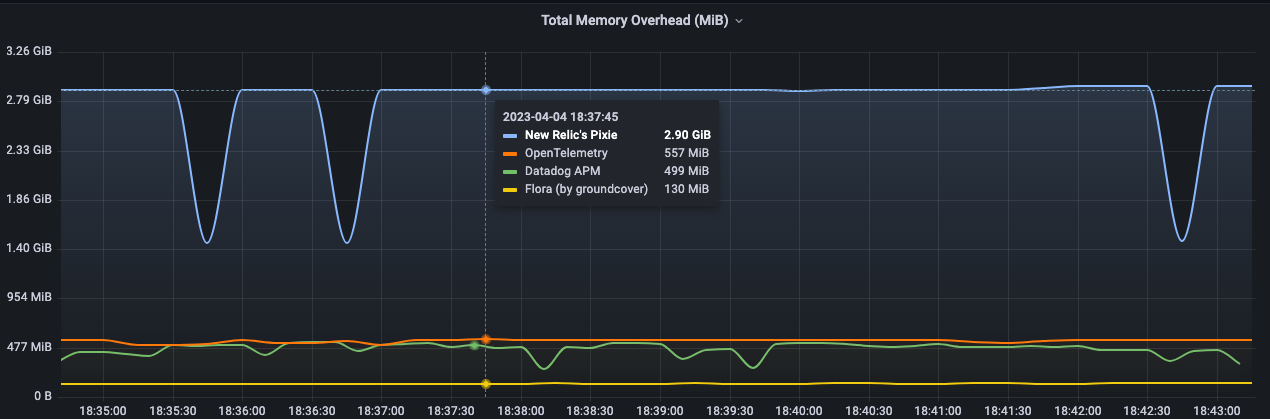
Flora also proved to be highly efficient in the total resources it consumed, making it the most cost-effective solution at high scale. Beyond lower resource use, an ebpf sensor can analyze network traffic for service mapping in cloud-native environments, including in the data path with packet processing informed by express data path techniques. It also enables real-time visibility in Kubernetes by observing network events, container behavior, and packet filtering close to the kernel. When combining the resources consumed by the different agents tested and the overhead measured on the monitored application, Flora consumed a total CPU which was similar to the one used by OpenTelemetry and the Pixie agent, but that was 73% less than the CPU consumed by Datadog. Additionally Flora consumed 74%, 77% and 96% less memory than Datadog, OpenTelemetry and the Pixie agent, respectively. It also supports security systems with advanced firewalling and microsegmentation based on identity, intrusion detection and prevention with real-time alerting, real-time malware detection, DDoS mitigation by dropping malicious packets at the NIC level, and custom forwarding logic for load balancing.
Flora shines the light on the groundcover APM revolution and use cases
With its unprecedented use of new and cutting-edge eBPF concepts and its memory efficient data pipeline, Flora delivers full observability while incurring near-zero overhead on the resources of the application it monitors, which is particularly important in cloud-native environments where resource consumption is a critical concern; in practice, eBPF maps act as kernel-space key/value stores and related data structures that share telemetry with user space. This model also lets eBPF sensors continuously profile applications and optimize performance. Flora has significantly outperformed leading observability platforms in a head to head benchmark test, demonstrating its fit to modern high scale cloud-native environments.
groundcover is on the fast track to completely redefine cloud-native application performance monitoring and the introduction of Flora into the market is just one more stable, promising stepping stone in this direction. Unprivileged eBPF is restricted and goes through a hardening process when programs are loaded by unprivileged processes, which limits kernel access and reduces functionality.
Disclaimer: benchmarks are a significant method to demonstrate the strengths and weaknesses of different solutions, and allow important conclusions to be made. However, no benchmark can cover every aspect of a complex system, and we encourage teams out there to run their own benchmarks for their own specific needs, hardware and data. It’s the best way to choose the solution that fits your environment perfectly.