Cascading Failures: Causes, Prevention Strategies & Best Practices




One service slows down. Then another fails. Within minutes, your entire system is offline. This is a cascading failure. A single component problem triggers a chain reaction that takes down everything. Queue-It downtime statistics roundup reports that for 48% of enterprises, hourly downtime costs exceed $1 million. Cascading failures can significantly extend recovery because retry amplification and queueing effects can drive a service into a ‘death spiral’ unless traffic is limited and the triggering condition is addressed, according to Google SRE.
The problem isn't that components fail. They always do. The problem is when failure spreads. What starts as a slow database query becomes timeout errors in your API layer, which triggers retry storms that overwhelm your load balancers and crash your entire platform.
This article explains what cascading failures are, how they happen, and why they are so bad for distributed systems. You'll learn the most common causes, real-life examples, and tried-and-true methods for spotting and stopping cascades before they bring down your whole platform.
What Are Cascading Failures and Why They Matter
Cascading failures occur when one component failure triggers failures in dependent components, which trigger more failures, creating a feedback loop that amplifies across your entire system. Unlike isolated failures, where a single service goes down, and others continue working, cascading failures spread through dependencies until the whole system becomes unavailable.
The term originated in power grid engineering. When one transmission line failure causes load to shift to other lines, those lines can overload and fail, spreading the problem across the grid. The same pattern appears in distributed software systems. Complex systems with many dependencies are particularly vulnerable. According to Uptime Institute research, approximately 40% of major outages are caused by human error during routine changes, often triggering cascading effects that far exceed the initial scope of the problem.
How Cascading Failures Start and Spread
Cascading failures don't start with catastrophic events. They start small and amplify through feedback loops.
Initial Failure Triggers
The initial trigger can be anything that reduces capacity or increases latency. A database query that normally takes 100ms suddenly takes 30 seconds. A deployment introduces a memory leak. A traffic spike hits during a product launch. A configuration change accidentally reduces the connection pool size. These triggers create a small problem that other parts of your system respond to in ways that make it worse.
Positive Feedback and Load Amplification
The killer mechanism in cascading failures is positive feedback. Your service starts returning errors. Clients retry failed requests. Now you're handling 2x the load. More requests fail. More retries happen. Within 30 seconds, 100 requests per second become 500 requests per second, all failing.
Research on cascading failure patterns shows that this feedback loop is present in most distributed systems with retry logic. Load balancers make this worse. When health checks fail, load balancers may remove or deprioritize servers from rotation, forcing fewer instances to handle the same traffic. The remaining servers get overloaded. The feedback loop accelerates until everything is gone.
Chain Reactions Across Dependencies
Failures spread through dependency chains. Service A depends on Service B. Service B depends on Service C. When C slows down, B's threads block waiting for C's responses. B's thread pool exhausts. B stops responding. A's requests to B timeout. A retries. Now, B gets even more load while already struggling. Here's what the progression looks like:
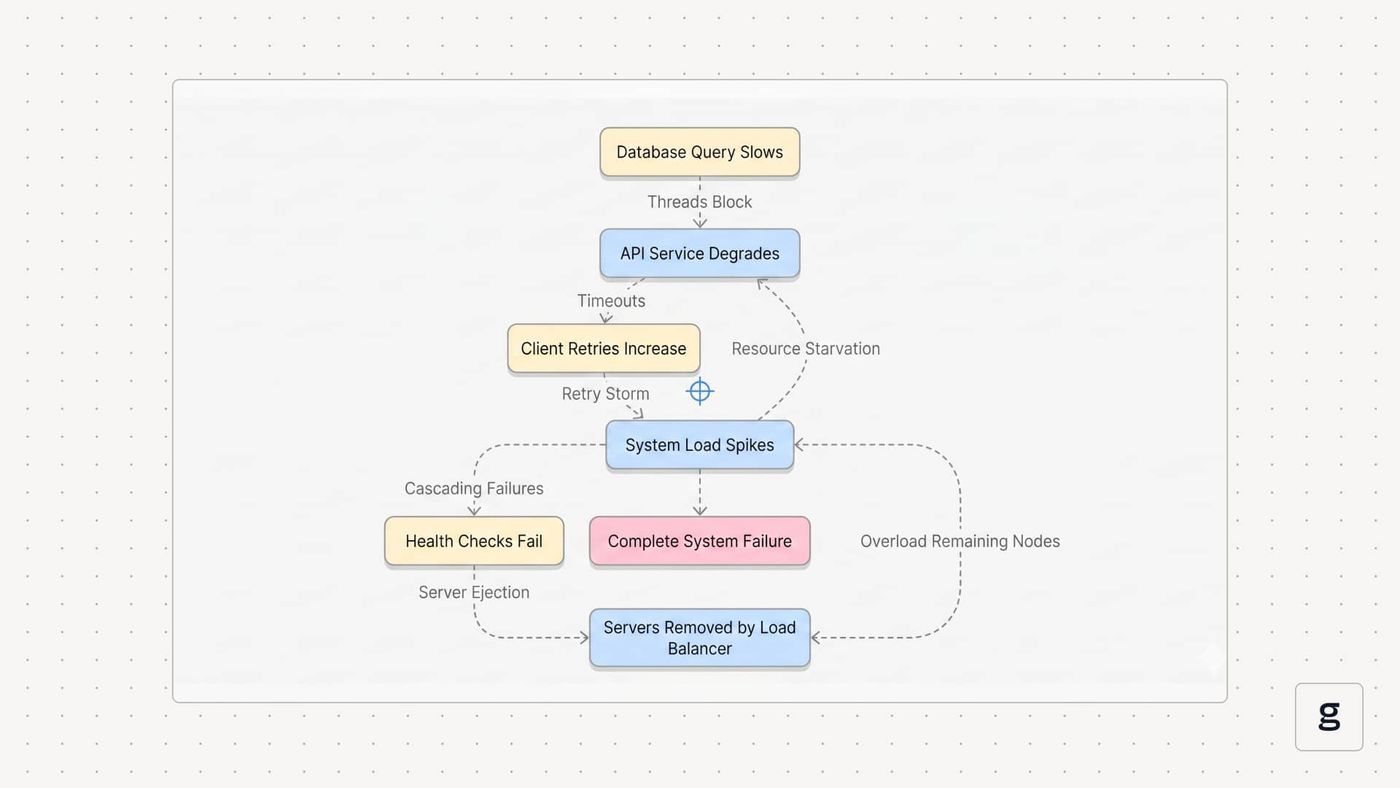
Degraded Mode Recovery Loop
Common Causes of Cascading Failures
Cascading failures don't just happen. Specific patterns trigger them:
| Cause | How It Triggers Cascade | Example Scenario | Prevention |
|---|---|---|---|
| Server Overload and Resource Exhaustion | Service runs out of memory or CPU, response times degrade, dependent services timeout and retry | Payment API hits 95% CPU during Black Friday, all transactions take 10+ seconds, checkout service times out and retries, 5x traffic spike crashes payment service | Horizontal autoscaling, resource limits per service, load shedding |
| Dependency Failures and Upstream Latency | Slow upstream dependency blocks calling service's threads, exhausts connection pools | Database query latency spikes from 50ms to 5 seconds, all API threads blocked waiting, new requests queue up, memory exhausts | Circuit breakers, timeouts, async patterns, fallbacks |
| Misconfigured Retries and Backoff Policies | Services retry immediately after failures, creating retry storms that amplify load 10x or more | Service returns 503 errors, clients retry immediately, each failure generates three retry attempts, 100 RPS becomes 400 RPS in seconds | Exponential backoff with jitter, retry budgets, client-side throttling |
| Deployment Rollouts and Configuration Changes | Bad deploy or config introduces errors, triggers widespread retries and fallback behavior | New service version has a memory leak, crashes after 10 minutes under load, triggers a rolling restart loop | Gradual rollouts, canary deployments, automated rollback |
Research from Brigham Young University shows load balancers designed to prevent failures often become the mechanism that propagates them, a pattern documented across 26 major incidents and validated in recent distributed systems failures.
Sectors Affected by Cascading Failures
Every industry running distributed systems faces cascading failure risks:
- Financial Services: The 2012 Knight Capital incident saw a bad deployment trigger cascading trading errors that lost $440 million in 45 minutes.
- E-commerce: Black Friday traffic spikes combined with any component failure create perfect cascade conditions.
- Cloud Providers: AWS, Google Cloud, and Azure outages affect thousands of downstream customers. The October 2025 AWS DynamoDB failure cascaded across dozens of services.
- Power Grid: The 2003 Northeast blackout started with a single tree touching a transmission line and cascaded to affect 55 million people.
Real-World Examples of Cascading Failures in Microservices
AWS DynamoDB October 2025
The AWS outage on October 19-20, 2025 started with a DNS issue affecting DynamoDB in the US-East-1 region. When it failed, errors cascaded to EC2, S3, Lambda, and dozens of other services that use DynamoDB internally for metadata storage.
The cascade mechanism: AWS services tried to read configuration data from DynamoDB. Those calls failed or timed out. Services retried. Retry traffic overwhelmed the already struggling DynamoDB cells. More services started failing. The outage lasted 15 hours and affected over 1,000 companies, including Snapchat, Venmo, and Robinhood.
Facebook BGP Configuration 2021
The October 2021 Facebook outage lasted 6 hours and cost an estimated $79 million. A routine maintenance command withdrew Facebook's BGP routes from the internet. No one could reach Facebook's servers, including Facebook engineers trying to fix it. Internal tools were also unreachable. Data centers couldn't coordinate. Physical access to data centers was controlled by badge systems that required network connectivity. The cascade affected every system simultaneously.
Risks and Impact of Cascading Failures
The costs of cascading failures exceed isolated component failures by orders of magnitude. Industry analysis shows enterprises lose $1 million per hour or more during downtime. Amazon reportedly loses $220,000 per minute during outages.
Recovery time is the killer. Cascading failures take 3 to 5 times longer to recover than isolated failures. You can't just restart failed services. The system is in a feedback loop. Bringing services back online immediately pushes them back into overload. Recovery requires careful orchestration, load shedding, and gradual traffic restoration.
Best Practices to Prevent Cascading Failures
Preventing cascades requires multiple defensive layers working together.
1. Load Shedding and Graceful Degradation
When your system starts to overload, shed non-critical traffic immediately. Drop low-priority requests first (analytics, recommendations). Return cached or stale data instead of making expensive calls. Disable resource-intensive features temporarily. Serve simplified responses that skip personalization.
Example: An e-commerce site under load might disable personalized recommendations while keeping core checkout working. That's graceful degradation.
2. Timeouts, Deadlines, and Cancellation Propagation
Every remote call needs a timeout. Without timeouts, threads block forever waiting for responses that never come. Here's proper timeout handling:
Set timeouts aggressively. If your normal p99 latency is 100ms, set timeouts at 200-300ms, not 30 seconds. Fast failure prevents cascades.
3. Circuit Breakers and Bulkheads
Circuit breakers stop calling failing services. Bulkheads isolate failures to prevent them from consuming all resources. Circuit breakers detect when a service is failing and stop sending requests temporarily. This gives the struggling service time to recover without additional load.
Bulkheads isolate different operations in separate thread pools. If calls to Service A exhaust their thread pool, calls to Service B still work because they use a different pool.
4. Resource Limits and Backpressure
Set explicit resource limits for every service. Memory limits, CPU limits, connection pool sizes, queue depths. When you hit these limits, reject new work rather than trying to handle everything and crashing.
5. Testing for Failure Under Load
Test cascading failure scenarios deliberately. Kill random service instances during peak load. Inject latency into specific dependencies. Exhaust connection pools. Simulate network partitions. Trigger retry storms deliberately. Measure how your system responds.
Strategies to Detect and Mitigate Cascading Failures
Early Warning Indicators
Cascades show specific patterns before complete failure: correlated error rate increases across multiple services, latency spikes across service boundaries, queue depth growth, thread pool exhaustion warnings, retry rate amplification, and memory pressure across services. Set up alerts that trigger on these patterns, not just individual service failures.
Degraded Mode Operations
When you detect a cascade starting, immediately switch to degraded mode. Activate circuit breakers manually across affected services. Shed load aggressively by dropping non-critical traffic entirely. Scale critical services first. Disable retries temporarily to stop amplification. Communicate with users that you're in degraded mode.
Eliminating Bad Traffic and Batch Loads
During cascades, some traffic makes the problem worse. Block clients retrying at high frequency without backoff. Defer batch jobs that can wait. Temporarily disable analytics, reporting queries, and non-critical background processing. Block expensive search queries and large file uploads.
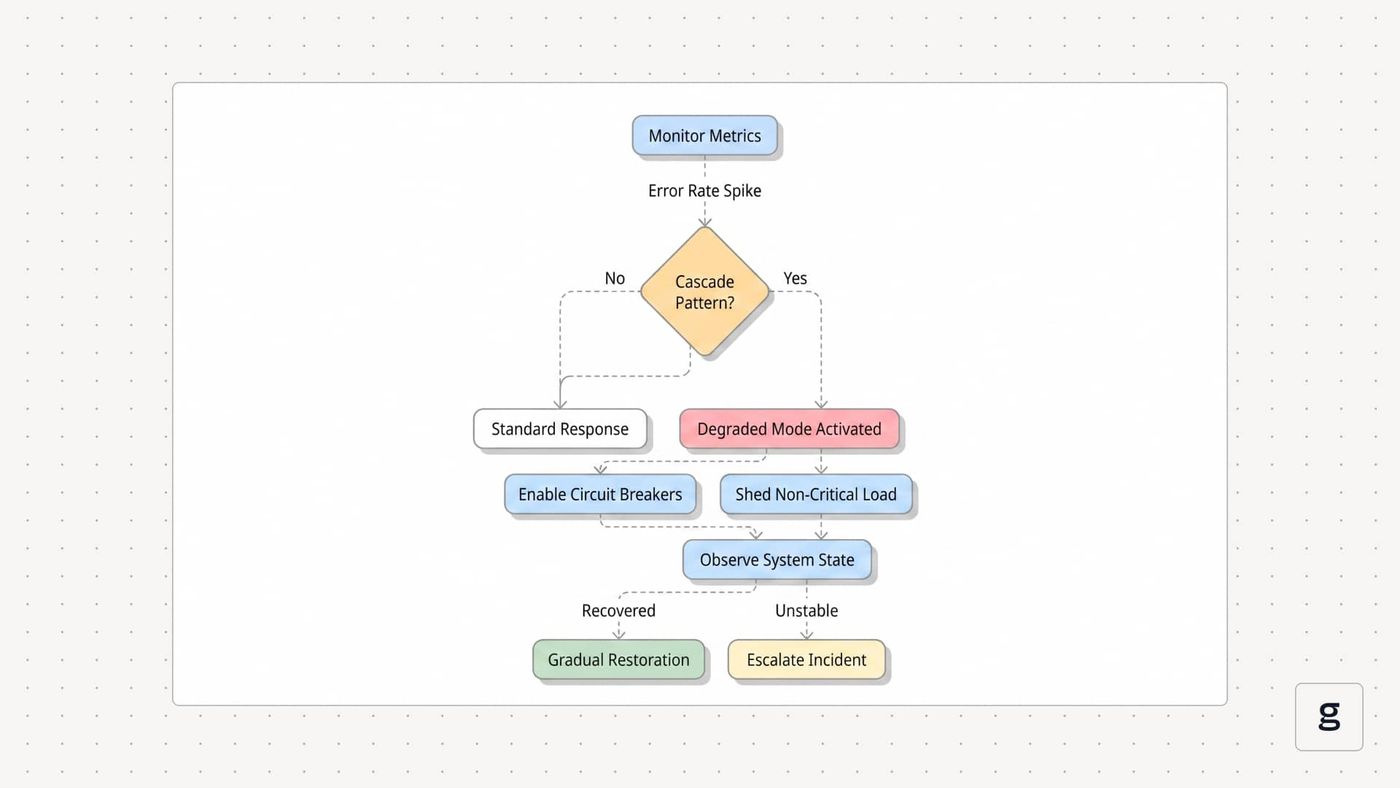
Decision & Mitigation Control Flow
Observability Requirements for Cascading Failure Detection
You can't detect cascades without seeing the entire system at once. Track request rates per service, error rates grouped by type, latency percentiles for all inter-service calls, queue depths, resource utilization, retry counts, circuit breaker state changes, and load balancer health check rates.
Alert on error rates increasing across 3+ services simultaneously, latency degradation spreading through dependency chains, traffic amplification where retry traffic grows faster than new requests, resource exhaustion approaching on multiple services, and rapid circuit breaker state changes.
The key is correlation. Individual service alerts don't tell you about cascades. You need to see patterns across services.
Tools and Frameworks for Managing Cascading Failures
| Tool/Framework | Purpose | Key Features | Use Case |
|---|---|---|---|
| Resilience4j | Circuit breakers, bulkheads, rate limiting | Lightweight, comprehensive metrics | Java/Spring microservices |
| Envoy Proxy | Service mesh, load balancing | Outlier detection, automatic retries with backoff | Kubernetes service communication |
| Istio/Linkerd | Service mesh, traffic management | Distributed tracing, traffic splitting, fault injection | Complex microservices platforms |
| Prometheus + Grafana | Monitoring and alerting | Time-series metrics, correlation analysis | Observability stack |
| Chaos Mesh / Gremlin | Chaos engineering | Failure injection, network latency simulation | Testing resilience |
Envoy's circuit breaking and outlier detection automatically remove unhealthy upstream hosts from load balancing pools based on success rates and latency.
How groundcover Helps Prevent and Detect Cascading Failures
Detecting cascading failures requires seeing how failures propagate across your entire distributed system. groundcover provides the system-wide visibility needed to catch cascades early.
- Real-Time Dependency Mapping: groundcover automatically maps service dependencies and visualizes how failures spread. When one service starts degrading, you immediately see which dependent services are affected and how quickly the cascade is progressing.
- Automatic Anomaly Detection: groundcover surfaces correlated failures across multiple services by correlating latency, error, and dependency signals in real time. It detects the early warning patterns like simultaneous latency increases and error rate spikes that precede cascades.
- Low-Overhead eBPF Monitoring: During cascading failures, your system is already under stress. groundcover uses eBPF to collect detailed metrics with minimal performance impact, even during high-load incidents.
- Root Cause Identification: When a cascade happens, groundcover helps teams trace back through dependency chains to identify the service most likely to have triggered the initial failure. You need to fix the root cause, not just restart everything.
Conclusion
Cascading failures turn small problems into system-wide outages through feedback loops and dependency chains. Prevention requires multiple layers: aggressive timeouts to fail fast, circuit breakers to stop calling failing services, bulkheads to isolate failures, load shedding when approaching capacity, and deliberate failure testing with chaos engineering.
Detecting cascades early makes the difference between a 5-minute incident and a 5-hour outage. Monitor for correlation across services. Watch for retry amplification. Alert on simultaneous latency spikes. When you catch a cascade in the first 30 seconds, recovery is straightforward.
Start with the services that have the most dependencies. Add circuit breakers and timeouts there first. Implement load shedding for non-critical traffic. Test deliberately by injecting failures during load tests. Complex systems will always have cascading failure risks. The goal isn't eliminating those risks completely. The goal is to contain them before they take down your entire platform.
FAQs
- Traffic vs Errors: Normal traffic spikes increase load while error rates and latency remain relatively stable.
- Error Amplification: Cascading failures show error rates rising faster than traffic volume.
- Latency Correlation: Latency spikes appear across multiple dependent services at the same time, not just one.
- Retry Explosion: Retry traffic grows beyond the original traffic spike, amplifying system load.
- Dependency Signal: If a core service (e.g., authentication) shows elevated latency and multiple downstream services simultaneously report timeouts, a cascade is beginning.
- Latency Percentiles: Rising p99 latency while p50 remains stable indicates early resource exhaustion.
- Queue Depth Growth: Increasing request queues despite normal incoming traffic signal degrading processing capacity.
- Error Rate Trends: Rapid changes matter more than absolute values. A jump from 0.1% to 1% errors within a minute is a strong warning signal.
- Request Stability: Risk increases when latency and errors rise without a corresponding traffic spike.
- Timeline Reconstruction: groundcover rebuilds the cascade timeline using distributed tracing and service dependencies.
- First Degradation Detection: It identifies the service that showed degradation before all others.
- Propagation Analysis: The platform traces how failures spread sequentially to downstream services.
- Event Correlation: Metric changes are correlated with deployments, configuration updates, and traffic shifts.
- Root Cause Isolation: The service that degrades first is typically identified as the cascade trigger.