Why groundcover Agent Mode Needs eBPF to See Everything
Learn why groundcover's Agent Mode relies on eBPF for complete visibility. See how connectors provide richer telemetry and more accurate AI investigations.

Introduction
Observability platforms help engineering teams capture the behaviors of software applications as they interact with the clouds and servers designed to host them. Platforms in the ecosystem have spent years coming up with guides for how to structure and collect their telemetry data. OpenTelemetry gives those teams the standard format for the data they should capture. eBPF (extended Berkeley Packet Filter) changes what gets captured in the first place.
The Instrumentation Assumption
In the past, developers manually built SDK integrations into their applications to simplify debugging and tracking as they shipped software. For mission-critical work, those SDKs told them how effectively their applications performed. The assumption was that instrumentation could always keep up.
The work of software engineers is now complicated by speed. They're forced to output more software, built with AI capabilities and by AI. Developers rarely spend sufficient time to understand what code generators built before moving to the next repository. Speed and complexity are breaking the assumption that instrumentation was enough. eBPF captures what nobody instrumented.
Only 22% of engineers are "very confident" their observability tools capture enough high-fidelity signals to detect real issues with AI — and AI is increasingly a core workload for all engineering teams. If observability is the record of ground truth, and uninstrumented code is invisible code, 78% of engineering teams are flying partially blind.
What eBPF Actually Does
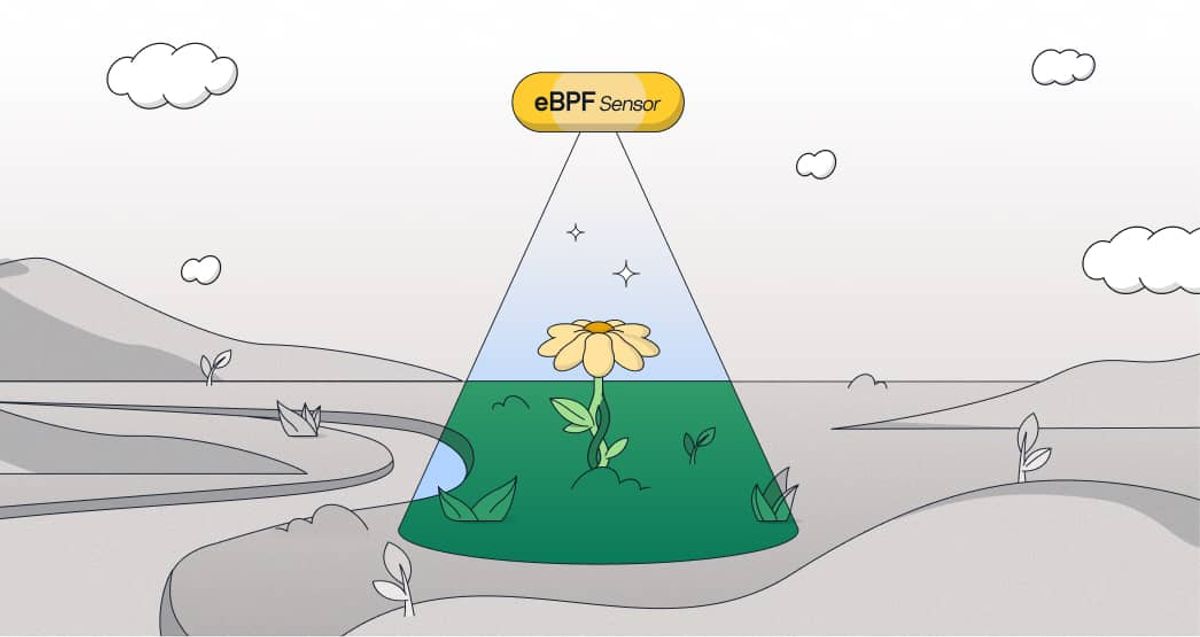
eBPF is a new concept for many people who first get introduced to groundcover. A Linux kernel is more familiar, so let's start there. The eBPF sensor is a process that sits at the kernel level and tracks the processes that execute in that kernel. It runs with the same privileged context as the kernel, so it captures network traffic and oversees the entire system. It extends the kernel's capabilities without modifying the kernel itself.
eBPF doesn't require code changes the way SDK-first approaches do — OTel, vendor-specific libraries — so it doesn't depend on a developer previously deciding to instrument something. The sensor intercepts traffic before it reaches the application layer of the kernel. It sees bytes on the wire. Every process on a Linux system — your app, your database, your service mesh — makes system calls to the kernel, so eBPF hooks can observe any of it. Network I/O, file reads, process spawning: it all flows through the kernel.
eBPF is an alternative when no instrumentation exists. It's a complement because it adds network-level context to apps already instrumented with OTel. Full waterfall traces still require instrumentation — that's the one thing eBPF doesn't deliver on its own. The greatest difference is that OTel and SDK-first approaches require intent. eBPF requires deployment.
The Scale Problem (and Why BYOC Is the Answer)
eBPF adds data volume, it doesn't reduce it. That extra data enriches your OTel traces — but SaaS observability vendors charge by volume, so better coverage means higher bills. Teams already sampling to control costs find eBPF makes the problem worse.
The only way to avoid that trade-off is to keep data in your own cloud. BYOC (Bring Your Own Cloud) eliminates the per-byte cost. You pay per node, not per gigabyte, so capturing more data doesn't mean paying more for it. No forced sampling. No blind spots by budget.
The Modern Stack: eBPF + OTel Together
OTel gives teams structure and depth where they chose to instrument. eBPF fills in the rest. The sensor watches all network traffic, file reads, and process activity, so you get a network topology of which services communicate and what they produce — including services nobody got around to instrumenting.
That topology serves two purposes. It shows you where adding OTel instrumentation would pay off. And it catches gaps your team never knew existed. Either way, you can act on what eBPF exposes rather than guessing at what's missing.
We covered how eBPF and OTel work as a complete stack in our OpenTelemetry blog. The short version: OTel adds waterfall depth where it matters. eBPF catches everything else.
Launch Story: Connectors Share a Complete Context
groundcover launched connectors this week to unlock the full value of eBPF and OTel data across your engineering stack. Customers can share their metrics, logs, and traces — the context groundcover Agent Mode uses — directly with coding and productivity tools via Model Context Protocol (MCP). Those tools include Slack, Linear, Jira, Claude Code, Codex, and Cursor.
With complete telemetry and connector access, Agent Mode can investigate an incident, identify the root cause, and push a fix through Cursor — without anyone pulling context manually. Engineers stop switching between tools. The data goes to where the work happens.
Conclusion
eBPF deploys in under an hour and immediately starts surfacing metrics, logs, and traces, including from services nobody instrumented. Months of SDK work isn't required to get that coverage.
That data becomes more valuable with connectors. groundcover Agent Mode draws on your complete telemetry — eBPF-captured and OTel-structured — and shares it with every tool in your engineering stack. Incidents that used to require manual context-gathering across multiple tools get investigated automatically.
Read more on the connector story here. To see what eBPF and OTel can do for your application data in 45 minutes, schedule time with a solutions consultant.