

Incident response is the organized process a security team uses to detect, contain, and recover from security incidents, with three goals: limit damage, limit downtime, and limit cost; the process starts long before an alert fires and ends after the team has turned the incident’s lessons into new controls. The cost of getting it wrong is measurable: IBM’s 2026 Cost of a Data Breach report, a Ponemon study sponsored by IBM, puts the global average breach at USD 4.99 million. This piece covers what incident response is, how events, incidents, and breaches differ, the lifecycle phase by phase, how NIST, SANS, and ISO 27035 compare, team roles and staffing, plan contents, tools mapped to each phase, evidence preservation, notification deadlines, a worked ransomware example, plan testing, and a closing FAQ.
What Is Incident Response in Cybersecurity?
Incident response cybersecurity work is a repeatable capability. It is a set of people, plans, tools, and evidence practices that turns an alarming signal into a contained, documented, and closed incident. A computer security incident response team (CSIRT) performs it. That team can be fully in-house, outsourced to a managed provider, or a hybrid with a retainer firm on call.
The process runs in a fixed order. You prepare plans, tooling, and logging. You detect and analyze the activity, then contain it to stop the spread. After that you eradicate the root cause and recover clean systems, and finally you review what happened and update the plan. NIST’s classic lifecycle names those phases Preparation, Detection and Analysis, Containment/Eradication/Recovery, and Post-Incident Activity. SANS splits the same work into six phases (PICERL), and ISO/IEC 27035 uses its own labels.
Events, Incidents, and Breaches: What Triggers a Response
These three terms describe different thresholds. Each threshold triggers different obligations, so your plan needs to define them the way the authoritative sources do.
- Event: NIST SP 800-61r3 defines an event as “Any observable occurrence involving computing assets, including physical and virtual platforms, networks, services, and cloud environments.” A failed login, a new process, and a firewall deny are all events.
- Incident: The NIST glossary, drawing on 44 U.S.C. § 3552, defines an incident as “An occurrence that actually or imminently jeopardizes, without lawful authority, the confidentiality, integrity, or availability of information or an information system; or constitutes a violation or imminent threat of violation of law, security policies, security procedures, or acceptable use policies.”
- Breach: NIST adopts the OMB M-17-12 definition, which covers loss of control, compromise, or unauthorized disclosure or acquisition where someone other than an authorized user accesses personally identifiable information, or an authorized user accesses it for an unauthorized purpose.
Most events never become incidents, and most incidents never become breaches. The escalation path matters because breach status is what starts regulatory clocks.
Incident types cluster into a small set. ENISA’s technical implementation guidance lists system failures and loss of availability, malicious code (including ransomware), denial of service (including DDoS), errors, breaches of confidentiality and integrity, and misuse of systems (including insider activity). The entry points are shifting. The 2026 Verizon DBIR found that exploitation of vulnerabilities is now the most common initial access vector at 31% of breaches, while credential abuse, the previous leader, fell to 13%. Phishing falls under social engineering, which Verizon groups with system intrusion and miscellaneous errors as 92% of breaches.
Incident response applies once an event meets your incident definition. You shouldn’t wait for proof of a breach. Waiting for certainty is how teams miss notification deadlines.
The Incident Response Lifecycle, Phase by Phase
In each phase, responders deliver a concrete output: in Preparation, they test the plan and establish usable telemetry; in Detection, they scope and severity-rate the incident; in Containment, they stop the spread while preserving evidence; in Eradication and Recovery, they return clean systems to production; and in the post-incident review, they update the plan. The phases below use the previous NIST four-phase model as a working structure.
Preparation
Preparation determines whether every later phase is possible. You can’t analyze logs you never collected or isolate assets you don’t know exist.
- Plan and authority: Write the plan, name who can declare an incident, and name who can take systems offline.
- Team and contacts: Assign roles, record out-of-band contact details, and sign any retainer before you need it.
- Asset inventory: Maintain a critical asset list that ranks systems by health and safety, revenue, and dependencies. CISA’s ransomware guidance uses this list for triage.
- Logging coverage: Confirm which sources you collect, how long you keep them, and whether they survive a host compromise.
- Tooling access: Pre-stage forensic accounts, snapshot permissions, and read-only evidence storage.
- Training and exercises: Run tabletop exercises so roles are familiar before the first real incident.
Preparation pays off in dollars. In IBM’s 2021 edition, the most recent edition with a cost figure for this practice in the retrieved data, organizations with an IR team that also tested their plan averaged $3.25 million per breach versus $5.71 million for those with neither.
Detection and Analysis
During detection and analysis, responders investigate a signal, scope the incident, assign severity and ownership, and write a timeline. Outcomes vary by who identifies the breach. IBM’s 2026 report states that internal IT or security teams identified 38% of breaches, MSSPs 31%, attackers disclosing the breach themselves 17%, and other third parties 14%. Breaches the attacker disclosed averaged USD 5.12 million against USD 5.01 million for internally identified ones.
Triage follows a fixed sequence:
- Validate the alert against raw telemetry, not the detection rule’s summary.
- Scope the blast radius: affected hosts, accounts, data stores, and time window.
- Assign severity using your matrix (see the escalation matrices later in this piece).
- Open the incident record and start a timestamped log of every action and every person involved.
- Flag regulatory triggers early: personal data, protected health information, material financial impact, or an essential service.
Dwell time shows why internal detection matters. In M-Trends 2025, Mandiant’s median dwell time was 10 days when organizations found malicious activity internally, versus 26 days when an external entity notified them.
Containment
Containment stops the attacker from spreading while preserving the evidence you need for eradication and notification decisions. Short-term containment buys time: isolate hosts, block indicators, disable compromised accounts. Long-term containment holds the line while you rebuild: segmented recovery networks, tightened access, and temporary compensating controls.
The CISA #StopRansomware Guide sets the isolation order. Isolate affected systems in a coordinated way and use out-of-band communication, such as phone calls, so the attacker isn’t alerted. If several systems or subnets are affected, take the network offline at the switch level. Power devices down only if you can’t disconnect them, because powering down destroys volatile memory evidence.
Capture evidence before you change anything. For cloud resources, CISA’s response checklist says to take a volume snapshot for later forensic review. Then contain.
Eradication and Recovery
Eradication removes everything the attacker left behind, and recovery restores service from sources you can prove are clean. CISA’s checklist sequences the work: kill or disable known malicious binaries, delete associated registry values and files, identify the systems and accounts used in the initial breach (including email accounts), remove persistence mechanisms, and patch the vulnerabilities used for entry.
The CISA checklist places credential resets after the environment is cleaned and rebuilt. Active Directory needs special handling: CISA countermeasure CM0050 says to reset the KRBTGT password twice, because the account keeps a two-password history, and to wait at least 10 hours between resets in large environments so the first fully replicates. The reset invalidates all AD-dependent tickets, so schedule it.
Recovery restores data from offline, encrypted backups in priority order. Rebuild on a clean network segment, such as a new VLAN that only clean systems join, and monitor restored systems for reinfection. The designated IT security authority declares the incident over against criteria the plan defines in advance.
Post-Incident Activity and Lessons Learned
Use the post-incident review to update plans and controls based on what happened. Run it blameless, so people report what they did and when without defending themselves. Build the timeline from the incident log, compare it to the plan, and record every gap.
Under NIST SP 800-61r3, teams feed lessons learned into the Improvement category of the CSF 2.0 Identify function and apply them across every other function. Teams can use those lessons to change a governance policy, an asset inventory, or a detection rule. NIST notes improvements often surface when teams write follow-up reports or hold lessons-learned meetings as recovery concludes, especially after major incidents.
NIST vs. SANS vs. ISO 27035: How the Incident Response Frameworks Compare
The three frameworks describe the same work with different boundaries, and NIST changed its structure in 2025. NIST finalized SP 800-61 Revision 3 on April 3, 2025, and withdrew Revision 2 the same day. Rev. 3 drops the four-phase model as its organizing structure and adopts the six CSF 2.0 functions. Govern, Identify, and Protect are treated as broader risk management that supports incident response, while Detect, Respond, and Recover are the response itself.
This table maps the phases using NIST’s own Rev. 3 crosswalk for the NIST columns:
The SANS six phases trace to the SANS Incident Handler’s Handbook by Patrick Kral, published February 2012. SANS has since published the Dynamic Approach to Incident Response (DAIR), which adds Verify and Triage and Scope steps and replaces the linear sequence with a loop of Scope, Contain, Eradicate, and Recover that repeats until no new evidence of compromise turns up. SANS still teaches PICERL alongside DAIR.
ISO/IEC 27035 has four current parts:
- Part 1 (2023, Edition 2) covers principles and process.
- Part 2 (2023) covers planning and preparing.
- Part 3 (2020) covers ICT incident response operations and is under review at stage 90.60.
- Part 4 (2024) covers coordination across organizations. The 2023 Part 1 confirms “Plan and prepare” and “Detect and report” as headings, and Part 2 references a “learn lessons” phase. The “assessment and decision” and “responses” labels come from the withdrawn 2016 model, so check the 2023 text before you cite them in an audit mapping.
Incident Response Team Roles and Staffing Models
A CSIRT has a technical core that works the incident and extension members who join when decisions leave the technical domain. ISO/IEC 27035-1:2023 added the terms “incident management team” and “incident coordinator” to its vocabulary, and the NCSC advises documenting who owns each responsibility and how to reach them.
Core CSIRT Roles
Each role below needs a named primary, a named backup, and an out-of-band contact. A plan can assign decision rights like these:
Extension Teams: Legal, Communications, and Executives
Extension teams join at specific triggers, and your plan should name those triggers. Legal joins as soon as triage flags personal data, health data, or possible material impact, because the GDPR and SEC clocks run from awareness and materiality decisions that legal must help make. A SANS paper on legal considerations recommends researching those legal decisions during the preparation phase. Forrester notes that a breach may require IR services covered under attorney-client privilege; legal can arrange privilege considerations before outside responders begin work.
Communications joins when an incident affects customers or will reach the public. The NCSC recommends pre-prepared messaging, defined notification processes, and alternative channels in case primary systems are down. Executives join when containment requires business-affecting decisions, such as taking production offline, or when a disclosure decision is needed. For US public companies, the registrant makes the materiality determination that starts the SEC’s four-business-day clock; your plan can assign executive and legal participants to that decision.
In-House vs. MSSP vs. Retainer Staffing
Each staffing model trades cost against context and coverage hours, and most organizations combine them:
- ENISA’s CSIRT and SOC setup guide adds EUR 3,000–10,000 per person per year for training.
- Digital forensics is among the most commonly outsourced functions. FIRST notes it requires significant expertise and costly resources, so paying per case is often cheaper than staffing it.
- In the SANS 2023 survey, 59% of organizations handled incident response completely in-house.
- No analyst source in the research publishes typical SLA hours for any model; the published figures are vendor-stated contract terms, such as one retainer brief listing 4-, 2-, and 1-hour initial response by tier. Treat SLA hours as something you negotiate.
- Sign the retainer early: Forrester warns that without a pre-arranged provider you “may have to switch providers mid-attack, losing precious time and insights in the handoff,” and recommends giving partners a detailed understanding of your environment, data, and executives in advance.
What Goes Into an Incident Response Plan
An incident response plan pre-decides the questions that are hardest to answer under pressure: who is in charge, what counts as severe, who must be told, and by when. It should stay short enough to use during an incident, with playbooks carrying the incident-specific detail.
Plan Components
A usable plan contains these sections:
- Scope and definitions: The systems, data, and subsidiaries covered, plus your definitions of event, incident, and breach.
- Roles and authority: The role table above, including who can declare an incident and who can take systems offline.
- Severity classification: A matrix with criteria and escalation triggers.
- Workflow: The lifecycle phases with entry and exit criteria for each.
- Communications: Internal escalation, regulator, customer, and media procedures, with out-of-band channels.
- Contact lists: Team members, executives, legal, retainer firms, cloud providers, insurers, and law enforcement (CISA, FBI field office, IC3).
- Linked plans: The NCSC recommends inter-linked business continuity, disaster recovery, and communications plans.
Severity Triage and Escalation Matrices
A severity matrix ties each level to impact criteria and to who leads. The UK NCSC model is a public reference that has run since 2018 and applies one six-level scale across all sectors:
To adapt the NCSC categorisation internally, replace national impact with business impact and map each level to who you wake up. Add escalation triggers that cut across severity: confirmed personal data exposure, a possible material financial impact, an essential service under NIS2, or for US federal agencies, the OMB M-22-05 major-incident threshold of unauthorized access to the PII of 100,000 or more people.
Playbooks by Incident Type
A playbook turns the plan’s workflow into specific steps for one incident type. Every playbook should contain the detection signals, the first three actions after declaration, the containment options with their evidence cost, eradication steps, recovery criteria, and the notification triggers that apply. MS-ISAC frames the test simply: does the plan define what an incident is, the next three steps once one is declared, and who has authority for each role?
- Ransomware: Isolate in coordination over out-of-band channels, power down only when disconnection fails, snapshot cloud volumes, report to CISA or the FBI whether or not you pay, check with law enforcement for decryptors, restore from offline encrypted backups by critical-asset priority.
- Phishing: Identify every recipient and every click, pull the message from mailboxes, reset credentials for anyone who entered them, and block the sending infrastructure and landing domains.
- Credential compromise: Disable or reset the account. A credential-compromise playbook can also specify session revocation, access-key rotation, and review of activity during the exposure window. For domain compromise, reset all domain and local accounts and KRBTGT twice.
- Data exfiltration: Establish what data left, how much, and whose it was, because those three facts drive every notification decision in the deadline table below; preserve egress logs before rotation deletes them.
Incident Response Tools Mapped to Each Lifecycle Phase
Each tool category earns its place in specific phases, and no single category covers all of them. This mapping shows where each category contributes:
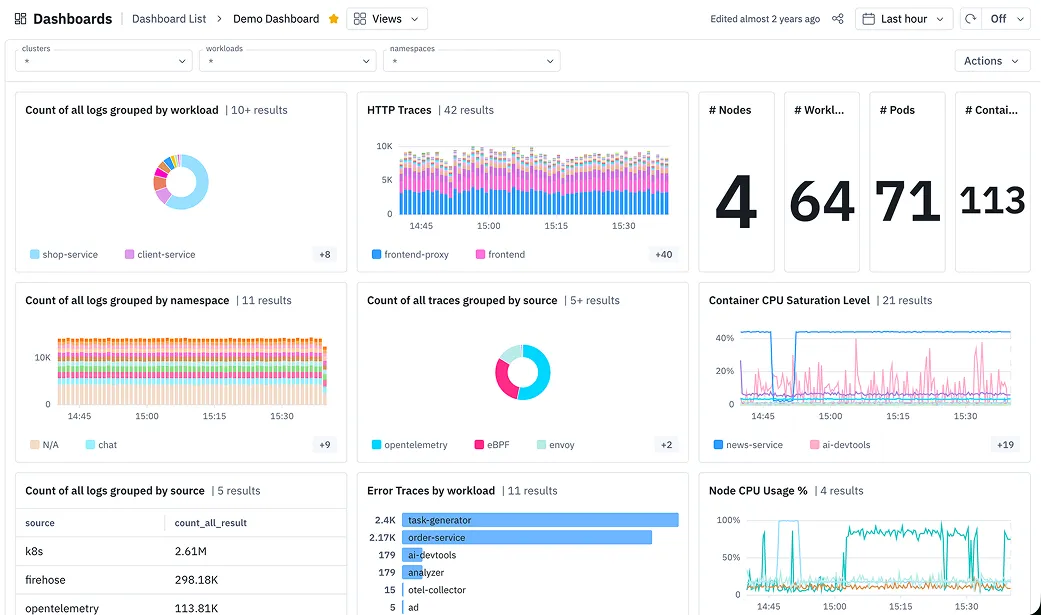
groundcover belongs in the observability row. It doesn’t provide SIEM, EDR, or SOAR. It sends alerts to PagerDuty, OpsGenie, Slack, incident.io, Rootly, and generic webhooks, so its signals reach the same on-call workflow as your security tools.
Why Full-Fidelity Telemetry Matters for Investigations
groundcover’s eBPF sensor runs as a Kubernetes DaemonSet, one pod per node, and observes network calls, HTTP requests, and system events from the Linux kernel with zero sampling.
That matters for incident response because sampling decides what to keep before anyone knows a request was malicious. A head-based sampler keeps or drops a trace when the request starts, so the one request that carried an exploit or exfiltrated a record has the same chance of being discarded as any healthy request, and the investigator then finds a gap exactly where the timeline needs evidence. Kernel-level capture also reaches services nobody instrumented.
Evidence location is the second issue. Telemetry routinely contains PII, session tokens, and internal topology. If your SaaS vendor acts as a processor and suffers a personal data breach, GDPR Article 33(2) requires it to notify you without undue delay; you then assess your notification duties. With groundcover’s BYOC deployment, you keep 100% of telemetry in your own cloud.
Know the limits before you rely on it. Kernel-level capture records what crossed the wire and the system call boundary; it can’t infer business context such as which tenant a request belonged to unless that context appears in the traffic.
If you want to validate the architecture on your own cluster, the free plan includes BYOC and requires no credit card. Evaluating on the free plan covers groundcover’s observability capabilities; it doesn’t mean Synthetics is included in that plan. Deploy groundcover’s eBPF sensor on one cluster and evaluate full-cluster visibility within hours under the documented deployment conditions.
Metrics: MTTD, MTTR, and Time to Contain
You can define these metrics from timestamps in your incident log:
- Mean time to detect (MTTD): Average time from the first malicious activity to detection. Measure it from the earliest attacker activity your investigation confirms, not from the first alert.
- Time to contain: Time from detection to the point the attacker can no longer spread. Measure it to the last containment action, not the first.
- Mean time to resolve (MTTR): Average time from detection to declared closure, with systems restored and the root cause removed.
IBM reports two related measures under its own methodology, MTTI (mean time to identify) and MTTC (mean time to contain). Its 2026 report puts MTTI at 183 days and MTTC at 64 days, a combined 247 days that reversed a five-year decline (the 2025 figure was 241). Mandiant’s M-Trends 2026 measures a related number, median dwell time, at 14 days, up from 11, with cyber espionage and North Korean IT worker incidents at a median of 122 days. The two datasets use different methods, so compare your own numbers against one of them, not both.
AI-assisted investigation targets the analysis time inside MTTR. groundcover’s AI Agent Mode answers natural-language questions across logs, traces, metrics, events, and entities, and pulls context from Slack, Jira, and GitHub, where engineers leave incident breadcrumbs. AI Agent Mode runs within your cloud through Amazon Bedrock. It also supports bring-your-own-LLM, and where a bring-your-own-LLM endpoint processes data depends on the endpoint you choose. groundcover hasn’t published an MTTR figure for AI Agent Mode, so baseline your own MTTR before and after adoption. The groundcover MCP Server gives compatible AI agents direct access to logs, traces, metrics, events, and production metadata. Use the groundcover MCP Server when you want observability context inside an IDE or incident workflow.
Evidence Preservation and Chain-of-Custody Checklist
Evidence you collect during detection and containment must survive legal scrutiny, so collect it in volatility order, hash it, and record every hand-off. Run this checklist before and during containment:
- Collect in order of volatility. RFC 3227 orders collection from registers and cache, through routing tables, process tables, and memory, then temporary file systems, disk, remote logging data, physical configuration, and finally archival media.
- Don’t shut down before collection. RFC 3227 warns that much evidence is lost at shutdown and that attackers may have altered startup and shutdown scripts to destroy it.
- Image, then analyze a working copy. Make a bit-level evidence copy of the media, preserve it, and analyze a separate working copy, because analysis alters file access times.
- Hash at acquisition and verify after. SWGDE guidance calls for an acquisition hash as early as practicable in collection; its evidence collection guidance calls for a verification hash after acquisition. SWGDE’s position names SHA-256 and SHA-512 with no known successful attacks; MD5 and SHA-1 remain acceptable for integrity verification but are collision-prone.
- Snapshot cloud resources before changing them. On AWS, enable termination protection, disable Delete on Termination for attached EBS volumes, and take EBS snapshots. On Azure, the Microsoft forensics reference architecture copies disk snapshots to immutable blob storage, stores snapshot hashes in a key vault, and applies a legal hold so evidence freezes as soon as it’s written.
- Extend log retention before rotation deletes evidence. CloudTrail Event history keeps 90 days of management events, the Azure Activity Log deletes events after 90 days, and Google retains Google-generated customer data access audit logs no longer than 30 days. Export to your own storage now.
- Centralize logs off the host. Mandiant recommends forwarding logs to a central location immediately so evidence survives a host compromise.
- Record access to the evidence. Give investigators read-only access to originals. Your evidence procedure should also record access to evidence storage.
- Document chain of custody. RFC 3227 lists where, when, and by whom evidence was found, collected, handled, and examined; who held custody, for what period, and how it was stored; and when and how custody transferred, including shipping numbers.
- Confirm data residency of every copy. Evidence containing personal data is still personal data; record which region and which provider holds each copy.
Regulatory Breach Notification Deadlines
Most notification clocks start during Detection and Analysis, when you become aware of a breach or determine materiality, not when the investigation ends. This table summarizes the current rules as of late November 2026:
Several qualifications change how you apply this table:
- GDPR awareness: The EDPB’s Guidelines 9/2022 state that failing to act in a timely manner can itself count as a failure to notify. The Digital Omnibus proposal would move the deadline to 96 hours and limit authority notification to high-risk breaches. Third-party reporting places the Council’s agreed position on 21 October 2026, but the Parliament procedure still shows “Awaiting committee decision,” so 72 hours applies.
- SEC delay: If the Attorney General determines disclosure poses a substantial risk to national security or public safety and notifies the SEC in writing, filing can be delayed up to 30 days, then a further 30, then in extraordinary national-security cases a final 60. Each extension requires a further determination and written notice. The DOJ guidelines require the Attorney General to invoke the initial delay within four business days of the materiality determination, so contact the FBI early. Trade groups petitioned for rescission in 2025 and 2026, but no adopted amendment appears in SEC releases in the research, and the SEC dismissed its SolarWinds case with prejudice in November 2025.
- HIPAA status: The Security Rule NPRM published January 6, 2025 was not finalized as of the research date. No source indicates that the November 2026 Privacy Rule final rule changes the breach notification rule.
- NIS2 significance: An incident is significant if it causes or can cause severe operational disruption or financial loss, or considerable damage to others. Implementing Regulation 2024/2690 adds sector thresholds, such as a cloud service completely unavailable for more than 30 minutes. Transposition is uneven: the Commission referred Ireland, Spain, France, and the Netherlands to the Court of Justice in July 2026.
- California law enforcement and private suits: SB 446 set the 30-day deadline effective January 1, 2026, and permits delay for law enforcement needs or to determine scope. The CCPA’s private right of action covers specified personal information and account credentials exposed through a business’s failure to maintain reasonable security, with statutory damages of $107 to $799 per consumer per incident or actual damages, whichever is greater. Statutory-damages claims require 30 days’ written notice and an opportunity to cure where possible; implementing reasonable security after a breach does not cure that breach. Individual claims solely for actual pecuniary damages require no pre-suit notice.
Worked Example: A Ransomware Incident From Detection to Lessons Learned
This hypothetical walkthrough follows a mid-sized EU-based SaaS company with US-listed shares through a ransomware incident, using the CISA checklist sequence. The timestamps show where each decision falls.
- Day 1, 02:14: EDR flags mass file renames on two file servers. The on-call analyst validates against raw telemetry and sees the same pattern starting on a third server.
- Day 1, 02:30: The incident commander declares a severity-1 incident and moves the team to a phone bridge, avoiding email in case the attacker reads it.
- Day 1, 02:45: The team snapshots the cloud volumes of affected VMs, then isolates the affected subnet at the switch level. One server can’t be disconnected remotely, so it’s powered down, and the loss of its memory evidence is logged.
- Day 1, 04:00: Scoping finds the entry point: an exploited VPN appliance whose logs never reached the SIEM. Egress logs show 40 GB sent to an unknown host before encryption began. Forensics hashes the images and opens chain-of-custody records.
- Day 1, 09:00: Legal reviews the exfiltrated share and reaches reasonable certainty that customer personal data was in it. That moment starts the GDPR 72-hour clock. The team reports to the FBI and CISA and asks about decryptors for the variant.
- Day 2, 15:00: Executives and counsel determine the incident is material. The four-business-day SEC clock starts. The GDPR notification goes to the supervisory authority with partial information, as Article 33(4) allows phased reporting.
- Days 2–4: Eradication. The team kills the ransomware binaries, removes registry persistence, patches and replaces the VPN appliance, and identifies the compromised service and email accounts used in the intrusion.
- Days 4–6: Recovery. Servers are rebuilt and data restored from offline, encrypted backups in critical-asset order onto a new recovery VLAN that only clean systems join. After the rebuild, all affected credentials are reset, and KRBTGT is reset twice, 10 hours apart.
- Day 6: The 8-K is filed. The security lead declares the incident over against the plan’s criteria and keeps elevated monitoring on restored systems.
- Day 20: The blameless review produces four changes: forward edge-device logs centrally, add egress volume alerting, extend log retention past 90 days, and add a VPN-appliance playbook. Indicators are shared with CISA and the sector ISAC.
Testing Your Incident Response Plan: Tabletop Exercises and Review Cadence
Test the plan at least annually, and again after anything that changes it. NIST SP 800-84 separates two exercise types. A tabletop exercise is discussion-only: a facilitator presents a scenario and participants talk through their roles without deploying equipment. A functional exercise has people perform their duties in a simulated operational environment, testing specific functions such as emergency notifications or IT equipment setup.
Cadence depends on what’s at stake. A NIST CSRC presentation on SP 800-34 Rev. 1 suggests a yearly tabletop for low-impact systems, a yearly functional exercise for moderate-impact systems, and a yearly full-scale functional exercise for high-impact systems. For card data environments, PCI DSS Requirement 12.10.2 requires reviewing and testing the plan at least once every 12 months, covering every element in 12.10.1, and its guidance names tabletop exercises as one way to test. That wording is from v4.0; PCI DSS v4.0.1 has been the only active version since December 31, 2024 and added or deleted no requirements.
You don’t have to build scenarios from scratch. CISA Tabletop Exercise Packages include ransomware, insider threat, phishing, and ICS compromise scenarios, plus planner and facilitator handbooks and an after-action report template; each exercise is designed to run about four hours.
Update the plan when any of these happen:
- After every major incident’s lessons-learned review (NIST SP 800-61r3; PCI DSS 12.10.6)
- After an exercise’s after-action report recommends changes
- After organizational changes, as NIST SP 800-84 advises
- When new guidance is issued or industry threats shift (SP 800-84; PCI DSS 12.10.6)
- When a notification rule changes, such as the Digital Omnibus amendments if adopted or a finalized HIPAA Security Rule
FAQs
Incident response handles a security incident from detection through lessons learned. Disaster recovery restores IT services after any disruption, malicious or not. They overlap in the Recover phase, which is why the NCSC recommends linking the IR plan to business continuity and disaster recovery plans instead of merging them.
Incident management is the broader discipline. ISO/IEC 27035 calls the whole cycle “information security incident management,” from planning and preparing through learning lessons. NIST SP 800-61r3 draws the same line: Detect, Respond, and Recover are incident response, while Govern, Identify, and Protect are wider risk management that supports it.
Start with NIST SP 800-61r3 for the lifecycle and CSF 2.0 mapping. Add ISO/IEC 27035 for incident-management planning and process, NIST SP 800-86 and RFC 3227 for forensics, the CISA #StopRansomware Guide for ransomware, and NIST SP 800-84 for exercises. Your regulators then set the notification rules.
Use NIST if auditors or regulators map your controls to CSF 2.0, because Rev. 3 is built on it. SANS PICERL splits containment, eradication, and recovery into separate phases, which suits hands-on playbook design. Both describe the same work, and SANS DAIR adds an iterative loop for incidents where scope keeps growing.
Not as a first move. CISA says to disconnect first and power down only if you can’t disconnect, because shutdown destroys memory evidence. Older FBI advisories, such as the 2022 Hive advisory, recommended powering off infected computers, so update any playbook still built on them.
No. The 96-hour deadline and high-risk-only threshold are proposals in the Digital Omnibus. The Council agreed its position in October 2026, but the Parliament hasn’t voted, so the 72-hour rule in Article 33 still applies.
No. Response starts when an event meets your incident definition. GDPR awareness requires reasonable certainty, not complete proof, and the EDPB treats slow action as a possible failure to notify, so waiting for full confirmation puts deadlines at risk.