Pod Security Policy Deprecated: Migration, Alternatives & Best Practices



Key Takeaways
- Kubernetes deprecated PodSecurityPolicy in v1.21 and fully removed it in v1.25, forcing teams to replace it or risk losing pod-level security enforcement during upgrades.
- PSP was removed mainly because it was difficult to manage at scale, had confusing RBAC bindings, lacked audit or dry-run modes, and behaved inconsistently across clusters.
- Kubernetes replaced PSP with Pod Security Admission and Pod Security Standards, which apply simpler, namespace-level security profiles (Privileged, Baseline, Restricted).
- Migrating safely requires auditing existing PSP rules, mapping them to Pod Security Standards, and rolling out enforcement gradually using audit and warn modes to avoid breaking workloads.
- Admission policies protect clusters at deploy time, but teams still need runtime visibility to detect privilege escalation, misconfigurations, or suspicious container behavior after workloads start running.
Kubernetes security has evolved significantly over the past few releases. Due to the announcement that pod security policy was deprecated in Kubernetes 1.21 and fully removed in 1.25, many organizations were forced to rethink how they enforce Kubernetes pod security controls.
According to the 2025 CNCF Annual Cloud Native Survey, 82% of organizations running containers now use Kubernetes in production. As adoption continues to expand across industries, consistent pod-level security enforcement becomes increasingly critical. As the clusters scale and workloads diversify, relying on outdated security controls significantly increases the risk of privilege escalation, insecure security context configurations, and misconfigured Kubernetes resources.
What Pod Security Policy Deprecated Means in Kubernetes 1.21–1.25
When Kubernetes announced pod security policy deprecation in version 1.21, it signaled that the feature would eventually be removed. In Kubernetes 1.25, PodSecurityPolicy (PSP) was fully disabled and no longer available in the API.
Originally, a pod security policy acted as a cluster-level admission controller that validated pods against defined security constraints before they were admitted.
Once PSP was removed:
- Existing clusters upgrading to 1.25 lost PSP enforcement.
- The policy/v1beta1 API was eliminated for PodSecurityPolicy specifically. Note that other resources previously under policy/v1beta1, such as PodDisruptionBudget, were migrated to policy/v1 rather than removed.
- Clusters relying on PSP had to migrate to alternatives.
- Admission controller configuration had to be reworked.
If you did not proactively migrate before upgrading, your Kubernetes pod security posture could silently weaken.
Why Pod Security Policy Was Deprecated and Removed
Although the PSP was powerful, it had some architectural and operational limitations. Kubernetes maintainers documented the reasoning in the official Kubernetes 1.25 release notes (kubernetes.io). The key issues included:
- Complex configuration and poor usability.
- Inconsistent enforcement behavior.
- Limited extensibility.
- Lack of clear security standards alignment.
PSP became difficult to manage in large environments where multiple namespaces required different privilege levels. Instead of patching the feature incrementally, Kubernetes introduced a simpler, standardized replacement: Pod Security Admission and Pod Security Standards.
Key Limitations That Led to Pod Security Policy Deprecation
The following table summarizes the major limitations that pushed PSP toward removal:
| Limitation | Description | Operational Impact |
|---|---|---|
| Complex RBAC Binding | PSP required explicit RBAC rules to associate policies with users and service accounts | Hard to scale in large clusters |
| No Dry-Run Mode | No built-in audit or warn capability | Risky to test policies |
| Inconsistent Defaults | Behavior varied across environments | Security drift between clusters |
| Hard to Debug | Errors were vague and non-intuitive | Increased troubleshooting time |
| Overlapping Controls | Confusion between PSP and admission controller configuration | Operational friction |
| Maintenance Overhead | Required constant updates for evolving Kubernetes resources | Increased management burden |
These limitations made Kubernetes security harder instead of easier, especially in regulated environments.
Security Risks After Pod Security Policy Deprecated
When pod security policy deprecated, clusters that upgraded without migration faced real security risks. These include:
- Privilege escalation via allowPrivilegeEscalation: true
- Containers running as root
- HostPath volume misuse
- Host networking exposure
- Misconfigured security context settings
Example of a risky pod spec:
Without proper enforcement, this configuration could expose the entire node filesystem.
What Replaced Pod Security Policy?
To address the shortcomings of PSP, Kubernetes introduced:
- Pod Security Admission (PSA)
- Pod Security Standards (PSS)
Pod Security Admission is a built-in admission controller that enforces predefined Pod Security Standards. Unlike PSP, PSA is:
- Namespace-scoped
- Declarative
- Easier to audit
- Simpler to reason about
Understanding Pod Security Standards After Pod Security Policy Deprecated
Pod Security Standards define three security profiles:
| Level | Description | Typical Use Case |
|---|---|---|
| Privileged | No restrictions | System-level workloads |
| Baseline | Prevents known privilege escalation vectors | Default production workloads |
| Restricted | Strict security controls | High-security or regulated environments |
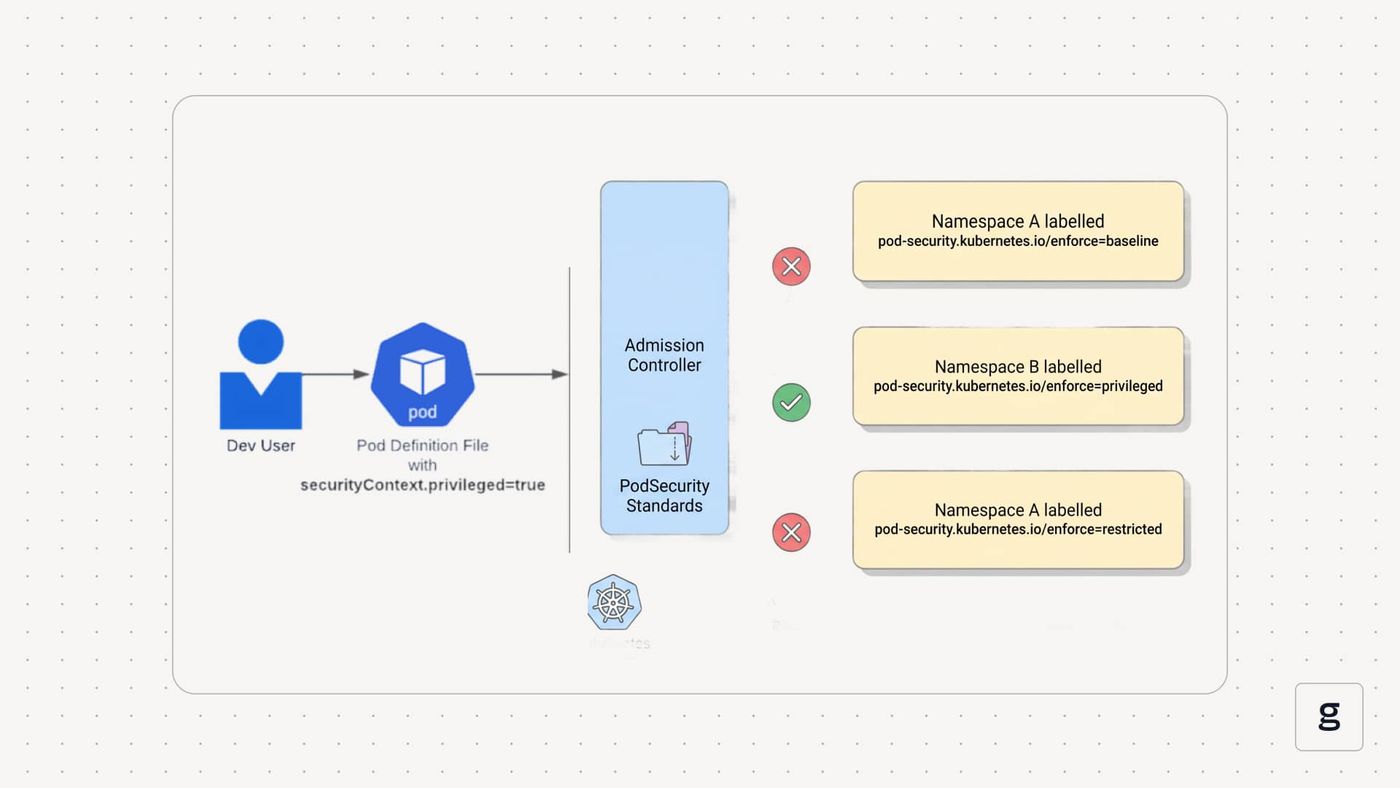
These are enforced using namespace labels:
This enables multi-mode enforcement:
- Enforce
- Audit
- Warn
A significant improvement over PSP’s binary behavior.
Using OPA Gatekeeper and Kyverno After Pod Security Policy Deprecated
While Pod Security Admission covers standard security needs, some environments require advanced policy logic. Two popular alternatives are:
OPA Gatekeeper enables custom policy enforcement using Rego:
Kyverno provides policy enforcement using Kubernetes-native YAML:
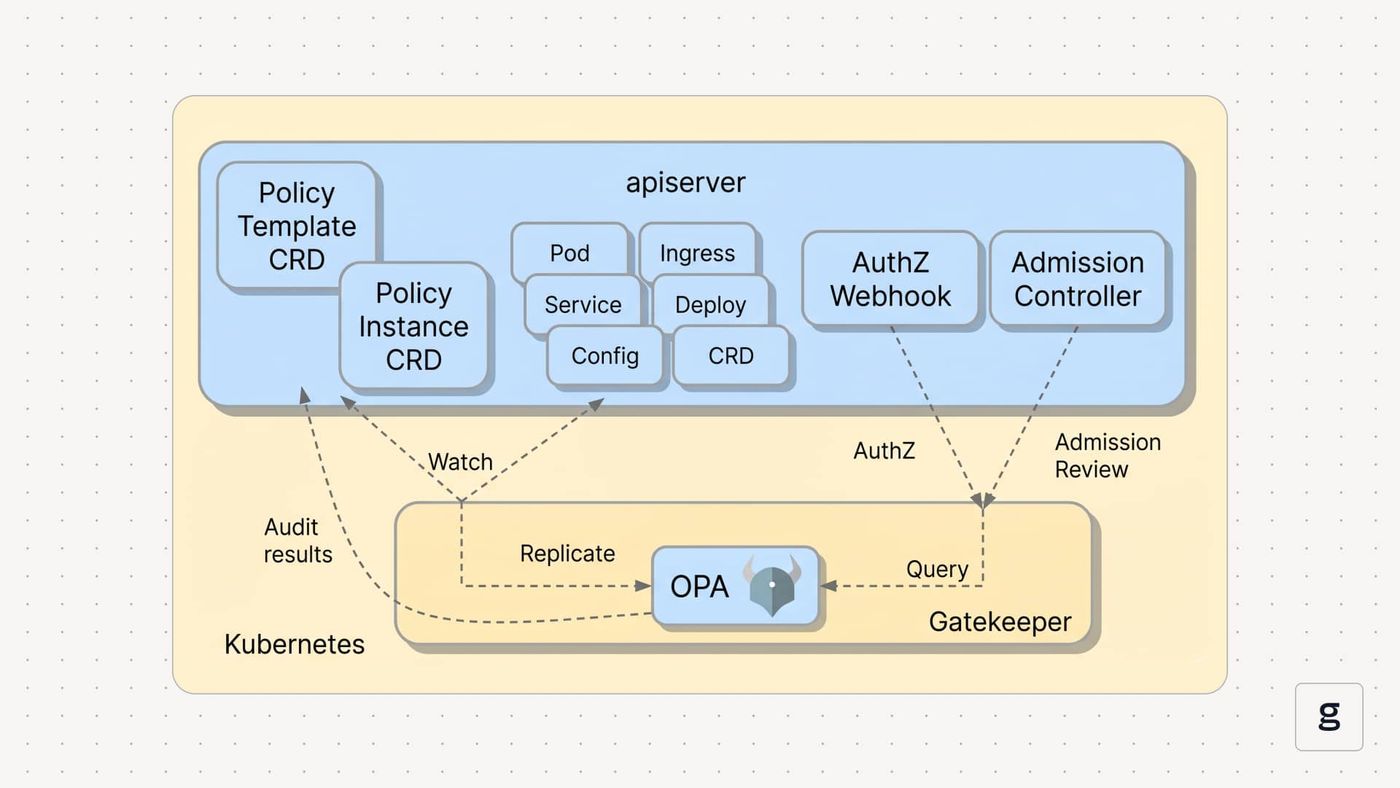
These tools allow fine-grained Kubernetes pod security enforcement beyond Pod Security Standards.
How to Migrate from Pod Security Policy
Migrating after pod security policy deprecated is not simply a matter of disabling PSP and enabling Pod Security Admission. A rushed migration can either break workloads or unintentionally weaken your Kubernetes pod security posture. A successful migration requires auditing, mapping, staged rollout, and continuous validation. Below is a structured approach that platform teams can follow:
Step 1: Audit Existing PSP Rules
The first step in any migration is understanding what your current PodSecurityPolicies are enforcing. Many organizations discover that PSPs were created years ago and never revisited.
Start by listing all PSP objects:
Then inspect each policy in detail:
Pay close attention to:
- allowPrivilegeEscalation
- runAsUser and runAsNonRoot
- Allowed volume types (especially HostPath)
- Host networking, PID, and IPC settings
- Required security context fields
- Capability restrictions
It is equally important to identify how each PSP is bound using RBAC. The RBAC bindings that a PSP uses are relied on heavily when determining which user(s)/service account(s) are allowed to use which policies. If this relationship is not accounted for during the migration process, production workloads may fail unexpectedly.
Document all findings before proceeding. This becomes your migration baseline.
Step 2: Map PSP to Pod Security Admission Levels
Pod Security Admission does not give custom rule definitions like PSP used to provide. Instead, it enforces standardized Pod Security Standards: Privileged, Baseline, and Restricted. Most PSP configurations map naturally to either Baseline or Restricted. However, some granular PSP rules may not have direct equivalents.
For example:
- PSP enforcing runAsNonRoot aligns with Restricted.
- PSP preventing privilege escalation aligns with Baseline and Restricted.
- PSP allowing host networking aligns with Privileged.
Create an internal mapping matrix between:
- Existing PSP rules
- Corresponding Pod Security Standards
- Required namespace labels
If certain PSP rules do not map cleanly, you may need to supplement enforcement using OPA Gatekeeper or Kyverno. This shows that disabling PSP does not reduce security coverage.
Step 3: Test With Enforce, Audit, and Warn Modes
One of the major improvements over PSP is the ability to use multiple enforcement modes simultaneously. Instead of enforcing immediately, start with audit mode:
Audit mode logs violations without blocking workloads. This allows teams to observe which deployments would fail under strict enforcement.
You can also enable warn mode to surface warnings at deployment time. When a pod spec is submitted, warn mode returns a warning in the API response, visible in kubectl output or CI/CD pipeline logs. Note that this is not a shift-left mechanism but rather to catch violations earlier in development, you'll need a separate tool such as kubectl --dry-run, or a policy linter integrated into your CI pipeline.
Monitor:
- API server audit logs
- CI/CD pipeline feedback
- Deployment warnings
Once violations are addressed, transition to enforce mode gradually.
Step 4: Gradual Rollout Across Namespaces
Applying Restricted enforcement cluster-wide without testing can cause widespread deployment failures. Instead, roll out in controlled phases:
- Development namespaces
- Staging environments
- Low-risk production workloads
- Critical production namespaces
This staged approach reduces operational risk and gives teams time to remediate workloads that rely on elevated permissions.
For example:
Namespace-level enforcement also makes it easier to isolate legacy workloads that may temporarily require Baseline or Privileged profiles. Over time, aim to reduce the number of namespaces operating under less restrictive profiles.
Common Challenges When Pod Security Policy Is Deprecated
When PSP is removed, organizations often encounter operational and security challenges.
| Challenge | Description | Mitigation Strategy |
|---|---|---|
| Policy Gaps | Not all PSP rules map directly to PSS | Use OPA or Kyverno |
| Legacy Workloads | Older apps require elevated permissions | Refactor or isolate |
| Namespace Sprawl | Inconsistent labeling | Automate namespace labeling |
| Privilege Escalation Risks | Improper security context settings | Enforce restricted baseline |
| Visibility Blind Spots | Admission-level enforcement only | Add runtime observability |
The biggest issue is visibility. Admission controllers validate at deploy time, not at runtime.
Best Practices After Pod Security Policy Deprecated in Kubernetes
After the pod security policy was deprecated, Kubernetes security must be intentional and layered. The following best practices help maintain a strong and consistent security posture across clusters:
- Default to Restricted Level for New Namespaces: The Restricted Pod Security Standard provides the strongest built-in safeguards against privilege escalation and insecure configurations. By setting this as the default for new namespaces, you ensure that workloads must explicitly justify elevated permissions rather than inheriting them unintentionally.
- Use Baseline Only When Necessary: The Baseline profile blocks known privilege escalation vectors but allows more flexibility than Restricted. It should be used only for workloads that genuinely require broader permissions. Overusing Baseline weakens the overall Kubernetes pod security posture.
- Avoid Privileged Unless Absolutely Required: The Privileged profile removes most security restrictions and should be reserved for system components or infrastructure-level workloads. Allowing general applications to run under Privileged significantly increases the attack surface and risk of container breakout.
- Regularly Audit Namespace Labels: Namespace labels control Pod Security Admission enforcement. Over time, configuration drift can occur due to manual changes or new deployments. Periodic audits ensure that namespace-level enforcement aligns with organizational security policies.
- Combine Admission Control With Runtime Detection: Admission controllers validate configuration at deployment time, but do not monitor runtime behavior. Combining Pod Security Admission with runtime observability ensures that suspicious actions, configuration drift, or privilege escalation attempts are detected after workloads start running.
- Monitor for Privilege Escalation Attempts: Even when admission policies are enforced, misconfigurations or new vulnerabilities can introduce risk. Monitoring runtime signals such as unexpected setuid calls, host namespace access, or elevated capabilities helps detect privilege escalation attempts before they cause damage.
- Automate Admission Controller Configuration via GitOps: Managing admission controller configuration as code improves consistency and traceability. Using GitOps workflows ensures that policy changes are reviewed, version-controlled, and automatically synchronized across clusters, reducing human error.
Security in Kubernetes must be layered and continuously validated. Admission controls provide a strong foundation, but ongoing monitoring and automation are essential to maintain resilience in dynamic environments.
Real-Time Kubernetes Security Visibility After Pod Security Policy Deprecated With groundcover
Admission controllers such as Pod Security Admission validate Kubernetes resources before deployment, ensuring that pod specifications comply with predefined security standards. However, configuration validation alone is not sufficient. Runtime behavior can still introduce security risks that admission controls cannot detect.
After pod security policy deprecated, organizations need runtime observability to identify potential security violations once workloads are running inside the cluster. This includes monitoring for:
- Privilege escalation attempts
- Suspicious or unexpected security context behavior
- HostPath volume misuse
- Unusual system call activity at the container level
This is where groundcover becomes valuable. It provides deep runtime visibility into Kubernetes environments using eBPF-based instrumentation, allowing security and platform teams to observe workload behavior without modifying applications or deploying sidecars.
Because groundcover operates using a BYOC (Bring Your Own Cloud) model, the observability stack runs directly inside your cloud infrastructure. This architecture helps organizations retain full control over telemetry while avoiding the need to send sensitive runtime data to external SaaS platforms.
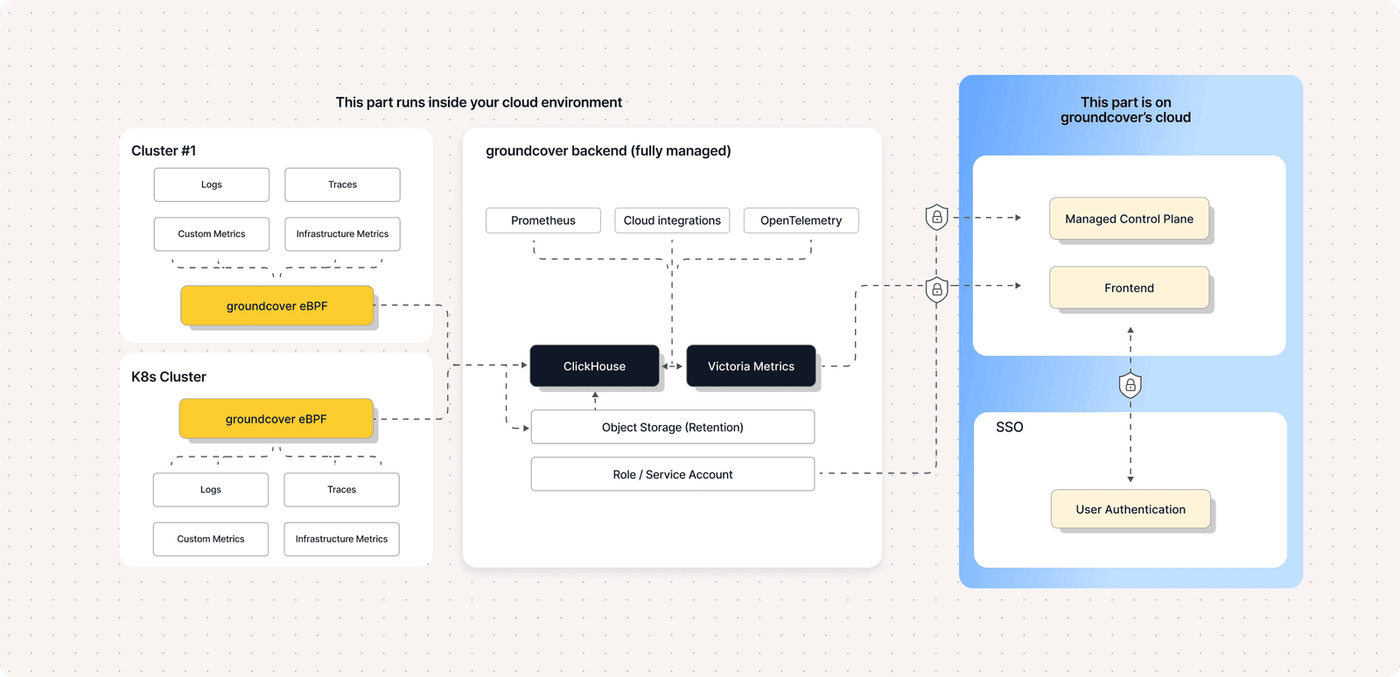
Using groundcover’s Kubernetes observability platform, teams can gain detailed insight into how workloads behave after they pass admission control. By leveraging eBPF-based telemetry, groundcover collects runtime signals from the kernel layer with minimal overhead and no sidecar deployment. These capabilities enable teams to:
- Track security context violations across running containers
- Detect deviations from Pod Security Standards after deployment
- Correlate runtime events with Kubernetes deployment changes
- Observe container-level system call activity and privilege behavior
With its self-service signup model and free tier, organizations can deploy groundcover quickly inside their own cloud environment and begin monitoring Kubernetes workloads without complex infrastructure changes.
While Pod Security Admission enforces static security policies at deployment time, groundcover complements these controls by providing continuous runtime observability. This helps close the visibility gap between configuration-based security enforcement and real-world workload behavior inside Kubernetes clusters.
Conclusion
The removal of PodSecurityPolicy marks a significant architectural shift in Kubernetes security. While PSP offered granular controls, its complexity limited scalability and predictability in modern environments. Pod Security Admission and Pod Security Standards provide a more structured and standardized enforcement model. However, admission control alone is insufficient for complete Kubernetes security. Organizations must combine namespace-level enforcement, advanced policy engines where required, and runtime visibility mechanisms to maintain strong protection. As Kubernetes adoption continues to expand, layered security - spanning admission, policy enforcement, and runtime detection - is essential to ensure resilient and secure clusters.
FAQs
The safest migration strategy is to translate PSP rules into PSS levels while filling gaps with additional policy engines where necessary.
- Create a rule mapping matrix that aligns PSP settings (e.g., runAsNonRoot, allowPrivilegeEscalation) with Baseline or Restricted profiles.
- Identify PSP controls that don’t exist in PSS, such as fine-grained volume restrictions or capability rules.
- Use OPA Gatekeeper or Kyverno for organization-specific controls not covered by PSS.
- Test enforcement using audit and warn modes before enabling enforcement across production namespaces.
Learn more about Kubernetes architecture and control layers.
eBPF enables kernel-level telemetry collection that exposes real container behavior after deployment, closing the gap between static security policies and runtime activity.
- eBPF captures system calls, network activity, and container privilege behavior without requiring sidecars or code instrumentation.
- Platform teams can detect unexpected privilege escalation attempts or host filesystem access in real time.
- Runtime signals can be correlated with Kubernetes events, deployments, and namespace policy changes.
- Kernel-level visibility enables low-overhead security monitoring across large clusters.
Learn more about eBPF observability.
A BYOC (Bring Your Own Cloud) architecture keeps observability data inside your infrastructure, reducing data exposure risks and improving cost and compliance control.
- Sensitive runtime telemetry, such as system calls, container behavior, and infrastructure events, remains inside your cloud environment.
- Security teams maintain full ownership over observability pipelines and retention policies.
- BYOC eliminates the need to ship large volumes of Kubernetes telemetry to external SaaS endpoints, reducing bandwidth and ingestion costs.
- Organizations operating in regulated environments or air-gapped clusters retain visibility without compromising compliance requirements.
Learn more about BYOC observability architecture.