groundcover Raises $100M Series C Funding
Discover how groundcover's $100M Series C will accelerate observability innovation. Learn what's next for AI-native infrastructure monitoring.


The layer that ends up mattering most is the one everything else quietly runs on.
Electricity is the clearest case. It never faded into the background - it climbed to the center of everything, until every invention that followed was built to assume it. Nobody builds a factory today and hopes there's power; they build on the certainty of it. Always on, everywhere, load-bearing for everything above it.
Observability is making that same move - but not the way people expect.
It began at the far end of the software lifecycle, a dashboard someone opened after the code shipped and broke. It's becoming the opposite: the live grid the whole software development lifecycle is built on, shipped on, and run on.
Software is getting its grid right now, and most companies still can't see theirs.

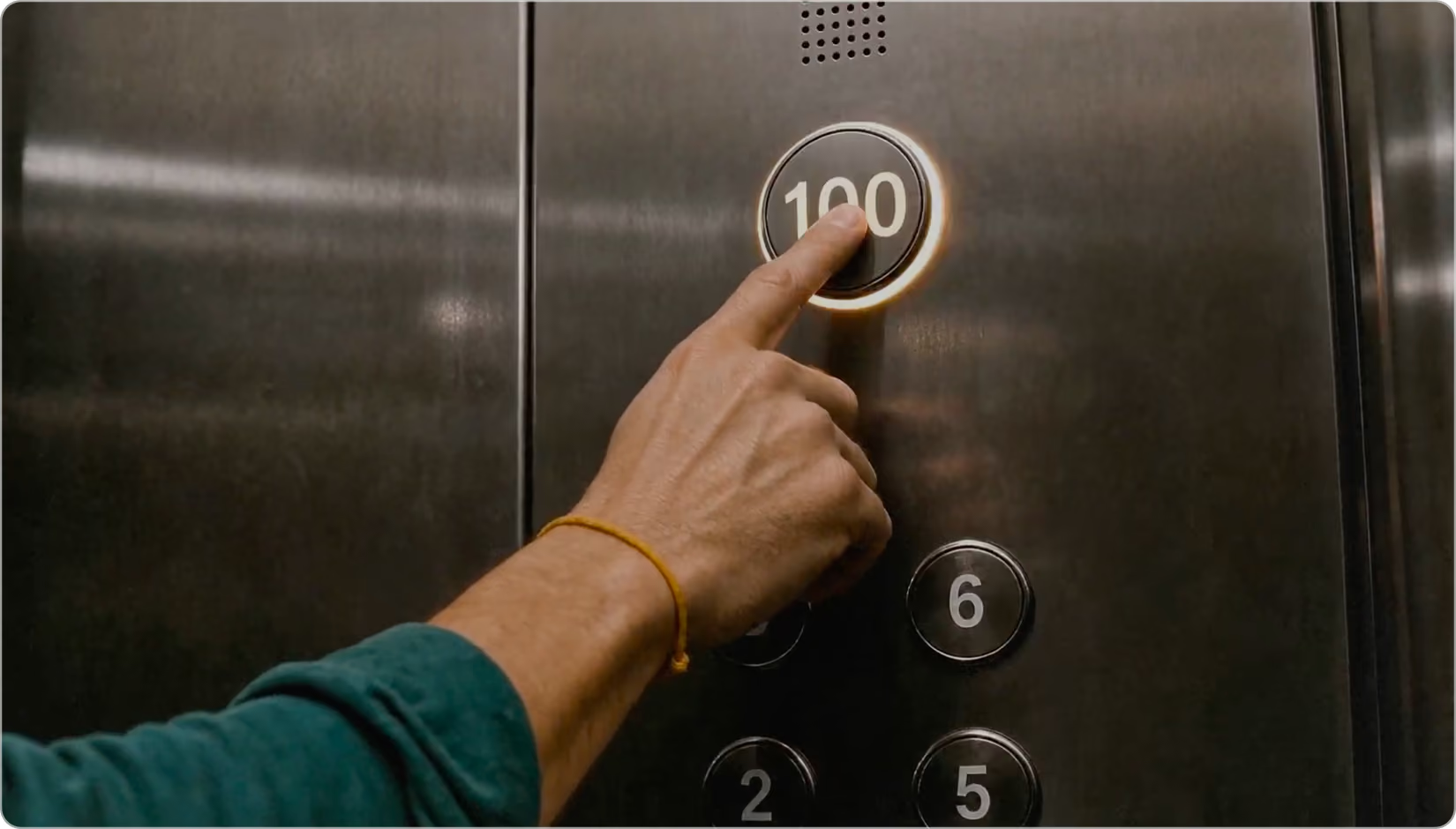
Software is turning autonomous
Agents write code. Not "assist with." Write. And they no longer stop at writing - they test and evaluate it, ship it, and fix it when it breaks, closing the loop while everyone sleeps. The whole software development lifecycle is going autonomous, one stage at a time, with fewer humans in the room every month.
Autonomous software needs its own foundational grid to operate.
Because agents don't run on intuition - they run on data. Abundance is their native element: where a human buckles under raw telemetry and reaches for less of it, an agent does the opposite. It feeds on the flood, turning vast, messy production data into context it can reason and act on. Turning raw signal into understanding is the one thing agents are unmatched at - and it is exactly what observability produces.
Which means the autonomous software life cycle is only ever as good as the grid beneath it. An agent turning raw observability data into action in production is only as reliable as the data that powers it: give it a partial, sampled picture and it acts on the gaps with total confidence; give it a complete one and it does what no human team ever could.
Today we're announcing a $100 million Series C to accelerate exactly that mission - to build the world's first true observability platform for the AI era, the grid autonomous software runs on. Observability is becoming core AI infrastructure, and we intend to change how engineers and agents collaborate and bring true autonomy into production operations.
A true grid cannot have gaps
A grid that goes dark is not a grid. A power company that browns out half the city to trim its fuel bill isn't running infrastructure. It's running a liability.
Observability never caught up, and AI is where legacy observability breaks.
The telemetry volumes required to monitor modern production environments are doubling every few months with the rapid adoption of cloud-native technologies,and are only accelerating with AI - as teams require deeper visibility into their AI stack and agentic workflows.
While telemetry keeps exploding and driving up spend, AI-native teams have a growing need for it - with new emerging use cases powering their agentic and autonomous operations. Legacy observability platforms cannot scale to this level, forcing teams to sample, throttle, silo, or see less of their telemetry data.
For twenty years our industry ran observability exactly that way. Sample this. Drop that. Throttle the rest. We taught an entire profession that forgetting most of their own data was discipline. It was never discipline. It was a grid with the lights half off, sold back to you as best practice. You throttle your telemetry today because you don't want the bill from Datadog. You already live in the brownout.
That was survivable when the only thing reading the data was a tired human who could sense when something felt wrong. It is not survivable now. Legacy observability platforms were designed to reduce data and require heavy manual instrumentation, creating gaps that engineers might tolerate but limit the power of AI agents.
Autonomous software needs its own foundational grid, and groundcover built its platform for that future. So instead, we offer full-fidelity telemetry, unsampled, across infrastructure, applications, and AI workloads, captured by an eBPF sensor with no code changes and no instrumentation. Paired with native OpenTelemetry support on top of that as a first-class citizen, this highly enriched telemetry allows teams and agents to have the full context they need to operate, fix issues in production and build better software, faster.
Finally, the lights stay on everywhere.
A grid you don't own isn't yours
You don't run your civilization on power you rent - least of all when you need more of it than ever before
Your production data is the most revealing thing you own, and it grows more sensitive and more enormous with AI, not less. Shipping it off to a legacy observability vendor's cloud, to be stored and priced by volume, was always the wrong trade - and the stakes are too high now to pretend otherwise. It creates a fundamental misalignment: your vendor makes money when you send more, so they price you into sending less - exactly the opposite of what you need. Because the moment you need every signal is the moment a crisis hits. And now that agents are wired into everything you do, that need is constant - you need it all in your hands, always accessible, at full scale.
Renting the layer your whole business runs on is a risk you can't take anymore. Your telemetry should live where your apps, systems, and AI run: inside your cloud. Your data, your models, your bill, your control.
That's what groundcover was built for - the companies defining the AI era, who need something fundamentally different. We built it from day one on a bring-your-own-cloud (BYOC) architecture built for AI-scale telemetry, stored and accessed privately and securely inside our customers' own cloud.
The AI era demands a completely different observability architecture, and groundcover is the only company that has built it. Our BYOC data plane lets teams keep full-fidelity telemetry with zero sampling and no cardinality limits - a data foundation where both engineers and agents can reach their full potential.
The world already runs on this
We’re announcing today a $100 million Series C, led by One Peak, with Morgan Stanley Expansion Capital and our investors Zeev Ventures, Angular Ventures, Heavybit, and Jibe, bringing us to $160 million in total.
This capital will accelerate our mission to become the world’s first true observability platform built for the AI era, designed for autonomous operations, large-scale, high-fidelity telemetry, privacy and control, as observability becomes core AI infrastructure.
AI-native companies are already migrating to groundcover.
b.well runs the healthcare backbone behind the world’s leading foundational AI company's flagship product, and it runs on groundcover. Under their legacy tool, they sampled production down to a quarter and dropped logs entirely to survive the bill. Today they sample nothing, ingest close to ten times more data, and pay less. Their engineers stopped thinking about cost and started keeping everything.
TRM Labs is about as AI-native as a company gets. Its product traces the flow of money across more than 55 blockchains to catch fraud, sanctions evasion, and financial crime - work no human team could do by hand. On groundcover, TRM cut its observability bill by more than 80% while collecting more than twice the data - the exact trade every legacy tool swore was impossible. Today every new service starts on groundcover by default. The grid stopped being a tool they chose and became the floor they build on.
More than 250 companies run on groundcover now, from first-round startups to the Fortune 5. We tripled revenue last year and doubled the team. We helped hundreds of teams move out of the limiting walls of Datadog, Grafana Cloud, and New Relic with automated migrations, deeper visibility and the architecture to support their need for AI-native telemetry at scale.
Coding is nearly solved. The hard part moved - from writing software to trusting it once it builds, tests, and runs itself, with fewer humans in the room every month. We built groundcover to be the grid that trust runs on: the complete, sovereign, always-on ground your AI-native stack deserves. Everything we ship next runs on it. Soon, everything you build will too.
Shahar Azulay, CEO & co-founder, groundcover