
LLM Evaluation Tools: Best Frameworks and Platforms in 2026



LLM outputs are non-deterministic, so the same workflow can produce different answers across runs. When prompts, retrievers, models, or agent flows change, quality can improve in one area and regress in another. For example, a prompt change may make the answer clearer but less accurate, a retriever update may add more context but reduce faithfulness, and an agent update may fix one tool path while breaking another.
LLM evaluation tools help you catch those regressions before release and monitor output quality in production. This guide compares the best LLM evaluation tools in 2026 for LLM outputs, RAG pipelines, and agent evaluation.
What Are LLM Evaluation Tools and Why Do Teams Need Them?
LLM evaluation tools help you define what a good output means, then measure whether an LLM application meets that standard. Unlike traditional tests that check one expected result, LLM evaluation often deals with answers that can vary while still being acceptable. That is why evaluation uses metrics, rubrics, reference answers, human review, code-based checks, and LLM-as-judge scoring instead of relying only on fixed pass/fail assertions.
Teams need them because LLM behavior varies across runs, so a response can appear correct while still failing on accuracy, grounding, safety, or tool use. Quality checks need to continue after development. Before release, you test curated examples to catch regressions. After release, you score production runs and turn failed examples into future test data.
LLM Evaluation vs. LLM Observability: Understanding the Difference
Evaluation and observability serve different jobs. One measures output quality, while the other shows the execution path behind that output. The table below shows how they differ.
Key Metrics LLM Evaluation Tools Should Measure
LLM evaluation tools should measure separate failure modes, not compress output quality into one score. Here is what they should track across accuracy, retrieval, agents, safety, cost, and regression risk.
- Hallucination Detection and Factual Accuracy: Hallucination detection flags false or unsupported claims in LLM outputs. Factual accuracy checks whether the answer is correct, while groundedness checks whether the answer can be verified against the source material.
- Coherence, Relevance, and Output Quality: Coherence shows whether the answer follows a logical structure. Relevance shows whether it answers the user’s actual question. Output quality covers readability, clarity, and whether the response fits the task.
- Tool-Call Accuracy for Agentic Workflows: Agentic workflows need checks for tool selection, tool arguments, and task adherence. These metrics show whether the agent chose the right tool, passed the right inputs, and followed the user’s request.
- RAG Faithfulness and Context Utilization: RAG evaluation needs to separate retrieval quality from answer generation. Faithfulness checks whether the answer stays grounded in the retrieved content. Context precision, recall, and utilization show whether the system found, ranked, and used the right evidence.
- Latency, Token Cost, and Regression Tracking: Quality scores should sit beside latency and token cost. Regression tracking shows whether a prompt, model, or agent update improved output quality while increasing response time, token usage, or cost.
- Safety, Bias, and Guardrail Compliance: Safety evaluation catches risks that relevance and accuracy scores may miss. These checks help flag unsafe guidance, toxic language, biased framing, protected-content issues, jailbreak attempts, and other guardrail violations.
Different failures need different checks. The goal is not just to mark LLM outputs as poor, but to show what needs to change before the next evaluation cycle.
10 Best LLM Evaluation Tools in 2026
Now that you know which metrics matter, let’s look at the best LLM evaluation tools, including what each tool is best for, its key features, main limitations, and pricing.
1. Braintrust - Best End-to-End Evaluation and CI/CD Integration
Braintrust is an AI evaluation and observability platform for datasets, experiments, scorers, production traces, and regression testing. It connects pre-release evaluation with production monitoring, so the same evaluation workflow can support prompt, model, RAG, and agent changes across development and production.
Key Features
- Supports datasets, experiments, prompt comparisons, custom scorers, human review, and online scoring for production traces.
- Captures LLM calls, tool calls, user feedback, attachments, latency, token usage, cost, errors, and custom metadata as trace spans.
- Provides LLM-as-judge and custom code scorers for quality, safety, accuracy, and task-specific checks.
- Includes a first-party GitHub Action for running evaluations in CI/CD and catching regressions before deployment.
- Supports agent evaluation by logging tool calls and reasoning steps as scoreable spans, which helps identify where a regression happened.
- Supports RAG evaluation through custom scorers and examples.
- Includes online scoring for production monitoring, with sampling options for live traffic.
Main Limitations
- It scores production runs after they are logged, so it does not block or rewrite unsafe responses at request time.
- Persona and edge-case testing use datasets and playgrounds, not a dedicated multi-turn simulation engine.
Pricing
Free Starter plan available. Pro starts at $249 per month. Enterprise uses custom pricing.
Best For
End-to-end evaluation workflows that need CI/CD regression checks, production scoring, and human review in one platform.
2. DeepEval - Best Open-Source Library for Unit Testing LLM Outputs
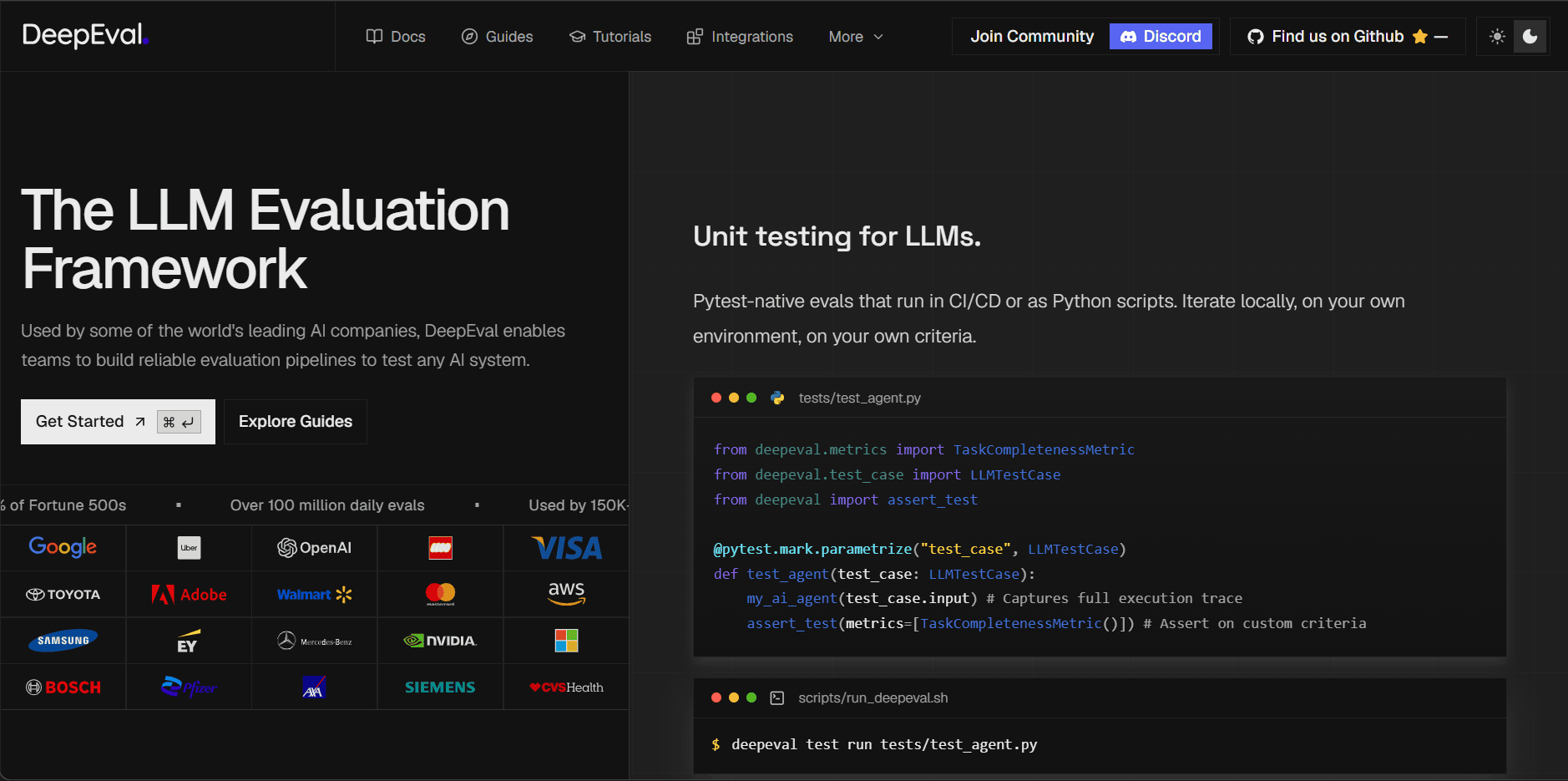
DeepEval is an open-source Python evaluation framework for testing LLM outputs, RAG pipelines, and agents. It uses a pytest-style workflow, so you can write test cases, run metrics locally, and add evaluation checks to CI/CD without starting from a managed platform.
Key Features
- Provides 50+ evaluation metrics for hallucination, faithfulness, answer relevance, contextual relevance, bias, toxicity, tool correctness, and task completion.
- Supports pytest-style LLM unit tests, standalone metric runs, bulk dataset evaluation, and regression tests in CI/CD.
- Includes RAG-focused metrics such as faithfulness, contextual relevancy, contextual precision, and contextual recall.
- Supports agent evaluation through ToolCorrectnessMetric and TaskCompletionMetric.
- Provides G-Eval for custom LLM-as-judge scoring when you need to define task-specific criteria.
- Supports deterministic custom metrics through DAG-based scoring logic.
- Includes synthetic dataset generation for creating golden test cases.
- Connects with Confident AI for hosted dashboards, production evaluation, reports, prompt versioning, and collaboration.
Main Limitations
- The core library is local-first and code-first. Shared reports, production monitoring, dataset management, prompt versioning, and non-engineer collaboration belong to Confident AI.
- It does not provide a native observability layer for production traces, logs, span views, or runtime dashboards.
- It does not track latency or token cost as a built-in evaluation signal.
Pricing
DeepEval is free and open source. Confident AI has a free tier, paid plans starting at $9.99 per user per month, and custom Team and Enterprise plans.
Best For
Open-source, pytest-style evaluation workflows that need repeatable unit tests for LLM outputs, RAG pipelines, and agent behavior.
3. Langfuse - Best for Eval-Integrated Observability and Self-Hosting
Langfuse is an open-source LLM engineering platform for tracing, prompt management, datasets, experiments, and evaluation. It connects evaluation results to production traces, so you can score runs, compare experiments, review feedback, and inspect the trace behind each score.
Key Features
- Supports LLM and agent tracing, including multi-step runs, sessions, user activity, token usage, cost, and metadata.
- Includes datasets, experiments, custom scores, user feedback, human annotation queues, and production trace scoring.
- Supports online and offline evaluation through SDK-driven and UI-driven workflows.
- Provides LLM-as-judge evaluation, code-based scores, categorical scores, numeric scores, and custom evaluation pipelines.
- Includes prompt management with versioning, labels, Playground testing, and deployment workflows.
- Supports RAG evaluation through custom evaluators or the documented Ragas integration.
- Supports OpenTelemetry, native SDKs, and integrations with common LLM frameworks and gateways.
- Provides a first-party GitHub Action for running experiments in CI/CD, reporting results on pull requests, and failing workflows when scores fall below a threshold.
- Can be self-hosted through Docker Compose, Kubernetes, and Terraform templates for AWS, GCP, and Azure.
Main Limitations
- Langfuse does not ship named built-in RAG metrics such as faithfulness, groundedness, context precision, or context recall. You implement those checks as custom evaluators or use the Ragas integration.
- Free-form text scores are useful for reviewer notes, but they are not supported in experiments, LLM-as-judge evaluation, or score analytics.
- Production self-hosting requires operating multiple stateful services, including Postgres, ClickHouse, Redis, and S3-compatible storage.
Pricing
Free cloud and self-hosted plans are available. Paid cloud plans start at $29 per month. Pro and Enterprise tiers add longer retention, governance, and security controls.
Best For
Self-hosted evaluation and observability workflows that need tracing, datasets, experiments, production scoring, and CI/CD checks in one open-source platform.
4. Arize Phoenix - Best for RAG Pipelines and Embedding Analysis
Arize Phoenix is a source-available AI observability and evaluation platform built on OpenTelemetry and OpenInference. It focuses on tracing, response evaluation, retrieval evaluation, datasets, experiments, and embedding-level analysis for LLM and RAG applications.
Key Features
- Captures traces for LLM calls, retrieval steps, tool use, prompts, custom logic, and agent workflows.
- Supports response and retrieval evaluation, including relevance, hallucination detection, QA correctness, toxicity, and summarization quality.
- Provides RAG evaluation through retrieval evals, response evals, and tools for inspecting retrieved context.
- Includes embedding analysis with UMAP visualizations, drift views, and cluster-level debugging.
- Supports datasets, experiments, prompt management, Playground testing, and prompt/model comparisons.
- Uses OpenTelemetry and OpenInference for vendor-neutral tracing and instrumentation.
- Integrates with OpenAI, LlamaIndex, LangChain, DSPy, AWS Bedrock, Anthropic, CrewAI, AutoGen, Haystack, LiteLLM, and other frameworks.
- Runs locally, in notebooks, through Docker or Kubernetes, or through Arize’s managed AX platform.
Main Limitations
- Local and notebook quickstarts do not persist trace history by default unless you configure a persistent database.
- Phoenix traces agent workflows, but it does not ship dedicated agent-evaluation metrics for tool-call accuracy or task completion.
Pricing
Phoenix OSS is free to self-host. AX has a free tier, and paid plans start at $50 per month.
Best For
RAG evaluation workflows that need retrieval debugging, response scoring, tracing, and embedding-level analysis in one platform.
5. Ragas - Best Specialized Framework for RAG Evaluation
Ragas is a free, open-source Python framework for evaluating RAG and LLM applications. It provides named retrieval and grounding metrics, including faithfulness, context precision, context recall, and answer relevancy. It runs inside Python workflows, so you can use it for code-first evaluation, CI checks, and experiments.
Key Features
- Provides RAG metrics such as faithfulness, context precision, context recall, and answer relevancy.
- Scores whether generated answers are grounded in retrieved context.
- Supports experiment-based evaluation loops for testing changes and comparing results.
- Lets you create custom metrics with Python decorators.
- Includes synthetic test data generation for building evaluation datasets.
- Track the evaluation cost for LLM judge calls.
- Integrates with LangChain, LlamaIndex, Langfuse, and Phoenix.
- Supports CI/CD through a documented pytest and GitHub Actions workflow.
Main Limitations
- Ragas does not provide native production observability, trace capture, dashboards, or live monitoring.
- Ragas has no self-serve hosted platform, so shared dashboards, production monitoring, and collaboration require another tool.
Pricing
Ragas is free and open source. Paid support is available through bespoke consulting, with no public SaaS pricing.
Best For
Code-first RAG evaluation workflows that need named metrics for faithfulness, context precision, context recall, and answer relevance.
6. MLflow - Best for Enterprise Multi-Framework Evaluation at Scale
MLflow is an open-source ML lifecycle platform that now includes GenAI tracing and evaluation. It brings LLM scorers, datasets, experiments, tracing, model registry, and deployment workflows into the same platform, which makes it useful when LLM evaluation needs to sit beside existing machine learning infrastructure.
Key Features
- Supports GenAI evaluation through built-in judges, custom scorers, and code-based checks.
- Includes named judges for retrieval groundedness, relevance, safety, and correctness.
- Provides RAG evaluation through RetrievalGroundedness, which evaluates responses against retrieved context.
- Supports multi-turn and session-level evaluation for agent workflows.
- Uses `@mlflow.test` for pytest-based regression testing.
- Includes tracing and autologging for GenAI calls.
- Supports TruLens feedback functions as MLflow scorers.
- Connects GenAI evaluation with MLflow’s experiment tracking, model registry, and deployment workflows.
Main Limitations
- Evaluation results live inside MLflow’s general Runs and Experiments model, not a dedicated LLM evaluation workspace.
- Bias and toxicity are not separate built-in judges. You need custom Guidelines-based judges for that level of safety scoring.
- The Review App for human feedback and continuous production monitoring are managed Databricks features, not standalone open-source MLflow features.
Pricing
Open-source MLflow is free to self-host. Managed MLflow is available through Databricks' usage-based pricing.
Best For
Enterprise evaluation workflows that need LLM evaluation inside existing MLflow or Databricks infrastructure.
7. Maxim AI - Best End-to-End Platform for AI Simulation and Agent Evaluation
Maxim AI is a proprietary platform for prompt experimentation, agent simulation, evaluation, and observability. It focuses on structured multi-turn testing, where you can run agents through scenarios, personas, and edge cases before release, then connect production logs back to evaluation datasets.
Key Features
- Supports prompt experimentation, prompt comparison, prompt versioning, and prompt deployment through Playground++.
- Provides an evaluator store with prebuilt and custom evaluators for task success, instruction adherence, RAG checks, and agent behavior.
- Runs persona-based and scenario-based simulations for multi-turn agent conversations.
- Tracks step completion, task success, instruction adherence, and conversational drift across longer sessions.
- Supports voice agent simulation and evaluation.
- Builds datasets from synthetic examples, production data, or both.
- Includes logs, traces, comparison reports, custom dashboards, and scheduled regression runs.
- Integrates with LangChain, LangGraph, OpenAI Agents SDK, LiveKit, CrewAI, Agno, LiteLLM, Anthropic, and AWS Bedrock.
Main Limitations
- Self-hosting is only available through Enterprise in-VPC deployment.
- Only the Bifrost gateway is open source, so Maxim’s evaluation and simulation platform remains proprietary SaaS.
Pricing
Maxim AI has a free Developer plan. Paid plans start at $29 per seat per month.
Best For
Agent evaluation workflows that need multi-turn simulation, persona testing, production logs, and regression checks in one platform.
8. LangSmith - Best for LangChain and LangGraph Native Evaluation Workflows
LangSmith is a proprietary observability and evaluation platform from LangChain. It captures traces through supported integrations, including LangChain, LangGraph, OpenAI, Anthropic, and CrewAI. For unsupported frameworks or custom orchestration, you can add traces with `@traceable`, a trace context manager, or the RunTree API.
Key Features
- Supports tracing, live monitoring, datasets, annotation queues, prompt testing, and online and offline evaluations.
- Provides LLM-as-judge and code-based evaluators for custom quality checks.
- Includes Prompt Hub and Playground workflows for prompt iteration and comparison.
- Connects evaluation results to traces, so you can inspect the run behind each score.
- Supports automatic tracing for LangChain, LangGraph, OpenAI, Anthropic, CrewAI, and other supported integrations.
- Includes LangSmith Deployment for hosting long-running agents.
- Provides LangSmith Engine for clustering failures, diagnosing root causes, and generating evaluation datasets.
- Supports bulk data export, feedback collection, and production trace analysis.
Main Limitations
- LangSmith is proprietary, even though LangChain and LangGraph are open source.
- RAG evaluation depends on custom evaluators rather than a named built-in RAG metric set.
- Self-hosting and hybrid deployment are Enterprise-only.
Pricing
LangSmith has a free Developer plan. Plus starts at $39 per seat per month, with custom Enterprise pricing.
Best For
LangChain and LangGraph evaluation workflows that need tracing, datasets, evaluators, prompt testing, and production monitoring in one platform.
9. Microsoft Foundry - Best for Teams Embedded in the Microsoft Cloud Ecosystem
Microsoft Foundry, formerly Azure AI Studio and Azure AI Foundry, is Microsoft’s Azure-native platform for evaluating and governing AI apps and agents. It ships with built-in evaluators for output quality, RAG groundedness, safety risk, textual similarity, and agent tool use. If your stack already runs on Azure, you can run evaluation inside the same cloud environment you use for model deployment, tracing, and governance.
Key Features
- Includes built-in evaluators for coherence, fluency, groundedness, relevance, retrieval, safety, textual similarity, and agent behavior.
- Provides RAG evaluators for retrieval quality, document retrieval, groundedness, relevance, and response completeness.
- Supports agent evaluators for task adherence, task completion, tool-call accuracy, tool selection, tool input accuracy, and tool output use.
- Includes risk and safety evaluators for hate and unfairness, self-harm, protected materials, indirect attacks, code vulnerability, and sensitive data leakage.
- Supports turn-level and conversation-level evaluation.
- Provides a local evaluation SDK through `azure-ai-evaluation`.
- Includes first-party CI/CD support through GitHub Actions and Azure DevOps.
- Uses Azure Application Insights for tracing and production observability.
Main Limitations
- Microsoft Foundry is cloud-only, with no self-hosted deployment option.
- Tracing runs through Azure Application Insights rather than a native tracing store inside Foundry.
- Cloud evaluation requires an Azure OpenAI or OpenAI-schema GPT chat-completion model as the judge.
Pricing
Microsoft Foundry access is free. You pay for the Azure services used, including model inference, compute, and Application Insights storage.
Best For
Azure-native evaluation workflows that need built-in evaluators, agent checks, RAG scoring, safety review, and Microsoft cloud governance.
10. Amazon Bedrock Evaluations and AgentCore Evaluations - Best for AWS-Native Agent Evaluation
Amazon Bedrock Evaluations and Amazon Bedrock AgentCore Evaluations cover different evaluation paths inside AWS. Bedrock Evaluations handles model and RAG evaluation jobs, while AgentCore Evaluations handles agent sessions, traces, tool calls, and trajectory checks. If your stack already runs on AWS, this gives you an AWS-native path for evaluating models, RAG systems, and agents without moving evaluation outside the Bedrock ecosystem.
Key Features
- Supports automatic model evaluation, human-based evaluation, LLM-as-judge evaluation, and RAG evaluation jobs.
- Provides RAG evaluation for checking retrieval and response quality against expected outputs.
- Supports AgentCore Evaluations for online production scoring and on-demand evaluation.
- Includes built-in agent evaluators for response quality, safety, task completion, and tool usage.
- Provides trajectory evaluators that compare actual tool-call sequences against expected tool execution.
- Supports custom evaluators through LLM-based prompts or code-based Lambda functions.
- Uses OpenTelemetry spans for agent-session evaluation.
- Integrates with AgentCore Observability for monitoring and real-time alerts.
Main Limitations
- Agent evaluation lives in AgentCore Evaluations, not the core Bedrock Evaluations feature.
- AgentCore Evaluations is available in fewer AWS regions than core Bedrock.
- Built-in evaluator models and prompt templates cannot be modified.
- General model evaluation jobs require models that are accessible through Bedrock.
Pricing
Automatic and LLM-as-judge evaluations use model inference pricing. Human evaluation adds $0.21 per completed task.
Best For
AWS-native evaluation workflows that need model evaluation, RAG evaluation, and agent trajectory checks inside the Bedrock ecosystem.
LLM Evaluation Tools Comparison Overview
Here’s a quick snapshot of the LLM evaluation tools we covered, based on the type of tool, whether it is open source, and whether you can self-host it.
How to Choose the Right LLM Evaluation Tool for Your Stack
The right LLM evaluation tool depends on how you run evals, where traces live, and how much control you need over data. Use the criteria below before comparing feature lists or pricing.
Identify Whether You Need Offline Evals, Online Monitoring, or Both
Offline evaluation runs before release against curated datasets, reference answers, rubrics, or expected behaviors. It helps you test prompt, model, retriever, and agent changes before they reach users.
Online monitoring scores live production runs after release. It helps you catch issues that curated test sets miss, including new user behavior, distribution shifts, and low-scoring outputs from real traffic. For production systems, look for a workflow that can turn failed traces, feedback, or reviewed outputs into future test data.
Match the Tool to Your Framework (LangChain, LlamaIndex, Custom)
Framework support affects how much instrumentation work you need. Native integrations can capture inputs, outputs, metadata, retriever steps, model calls, and tool calls automatically. Custom stacks usually need SDKs, decorators, context managers, API ingestion, or manual trace construction.
For RAG and agent workflows, trace depth matters more than framework name alone. The tool should show retrieval steps, generated answers, tool calls, arguments, intermediate steps, and final outputs separately, so evaluation can identify where the failure happened.
Assess Open-Source vs. Managed Deployment Requirements
Open-source libraries work well when you need local, code-first evaluation without a shared platform. Open-source or source-available platforms give you more control, but self-hosting can mean running databases, storage, queues, upgrades, and access controls yourself.
Managed platforms reduce that operational work and usually add dashboards, annotation workflows, prompt management, production monitoring, and collaboration features. Before choosing an “open-source” option, check whether it is truly OSI open source, source-available, or only self-hostable under specific license or tier conditions.
Evaluate CI/CD Integration and Regression Gating Capabilities
CI/CD support lets you run evaluations every time the application changes. Basic CI integration only reports scores. Regression gating goes further by failing a workflow or blocking a pull request when evaluation scores drop below a threshold.
Check whether the tool has a first-party GitHub Action, Azure DevOps extension, pytest integration, or documented CI workflow. “Possible with custom code” is weaker than a maintained integration with datasets, thresholds, score comparisons, and clear failure behavior.
Consider Data Residency and Privacy Constraints
LLM evaluation data can include prompts, responses, retrieved documents, tool arguments, tool outputs, feedback, and traces. That makes privacy and data residency part of the tool decision, not a later compliance step.
Check whether data stays local by default, moves to a managed cloud, or can run through self-hosting, bring-your-own-cloud, hybrid deployment, in-VPC deployment, or region selection. Also check which tier includes SSO, RBAC, audit logs, retention controls, SOC 2, HIPAA, GDPR, FedRAMP, and data processing agreements. These controls are often tier-specific, not available across the whole product.
Infrastructure Observability for LLM Applications: Where groundcover Fits
LLM evaluation tools tell you whether an output met the expected standard. groundcover helps with the next question: What happened around that output in production? It connects AI calls with Kubernetes workloads, services, logs, metrics, traces, events, and infrastructure signals, so a failed run can be investigated through the full runtime path, not only the prompt, model, or evaluator score.
Runtime Context Around AI Workflows
LLM applications often depend on retrievers, databases, tool APIs, and internal services before the model returns an answer. groundcover gives you visibility into that runtime path through logs, metrics, traces, Kubernetes events, infrastructure monitoring, and APM. Its eBPF-based APM captures HTTP requests, responses, and SQL queries, then enriches them with pod, node, and container metadata, so you can connect an AI workflow to the services and infrastructure behind it.
AI API Visibility Without SDK Code
groundcover’s AI Observability uses eBPF to detect supported AI API calls from workloads running on monitored nodes. For providers such as OpenAI, Anthropic, and AWS Bedrock, it can capture model name, token usage, cost, latency, prompts, and responses without adding SDK code. This gives you immediate call-level visibility into model usage, so you can see which service called which model, how long the call took, and how much the request cost.
OpenTelemetry for Full Agent Context
eBPF shows individual AI calls, while OpenTelemetry adds the workflow around them. groundcover uses OpenTelemetry to connect model calls to conversation IDs, agent names, tool calls, tool arguments, tool results, model details, token counts, and final outputs. That gives you a clearer view of agent and RAG behavior, from retrieval and tool execution through to the final response.
Kubernetes and Service Context Around Quality Drops
A low evaluation score does not always start at the model layer. The surrounding workflow may include retrieval issues, tool timeouts, schema changes, incorrect agent routing, dependency latency, or infrastructure pressure. groundcover places Kubernetes and service context beside the trace, so you can review CPU throttling, memory pressure, network behavior, deployment activity, and Kubernetes events near the failing run.
Agent Mode for Production Investigation
Agent Mode brings that investigation into natural language. It works in the groundcover UI and Slack, and it can query logs, traces, metrics, Kubernetes events, live entities, and monitor issues. For LLM applications, that means you can ask what changed in a namespace, why a service started returning errors, which dependency slowed down, or what happened around an incident. You then use the same assistant to create dashboards, monitors, and log parsing or drop rules from natural-language instructions.
Data Control for Sensitive AI Telemetry
AI telemetry can include prompts, responses, retrieved context, tool arguments, tool results, and user inputs. groundcover’s BYOC architecture keeps observability data in the customer environment on paid plans, including AI telemetry. Its GenAI privacy controls also let you disable GenAI data collection or keep operational metadata such as model, tokens, cost, and latency while removing prompt and response content.
Conclusion
LLM evaluation tools help you turn output quality into a repeatable evaluation process. The right choice depends on the workflow you need to protect. You may need offline regression checks before release, production scoring after deployment, RAG faithfulness checks, agent testing, human review, CI/CD gates, or tighter control over evaluation data.
A production workflow needs more than evaluation scores once an LLM application is live. You also need the runtime path behind each failed or degraded run, including model calls, service latency, Kubernetes events, dependency behavior, traces, logs, metrics, and AI API data. groundcover connects those signals so you can investigate whether a wrong answer, failed run, latency spike, or cost change started in the model layer, the service path, or the underlying infrastructure.














.svg)