Kubernetes Data Transfer Costs: Drivers, Visibility & Optimization



As you’re most likely aware, there are compute costs associated with operating the server infrastructure that supports a Kubernetes cluster. But did you know you may also need to pay Kubernetes data transfer costs?
If not, read on for details on what Kubernetes data transfer costs are, what causes them, how they can eat into your cloud bills, and best practices for mitigating expenses associated with Kubernetes data transfers.
What are Kubernetes data transfer costs?
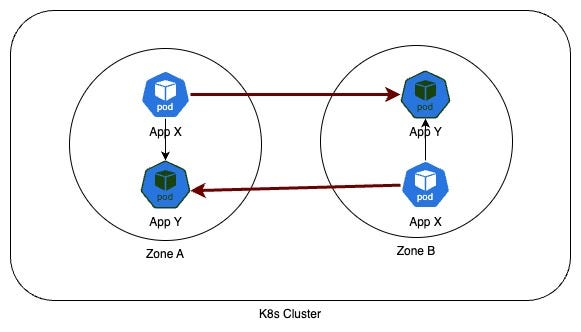
In Kubernetes, data transfer costs are fees that organizations pay to move outbound data between Kubernetes resources. These costs apply in scenarios where Kubernetes data transfers trigger cloud egress fees. Egress fees occur when data moves outside of a cloud availability zone (AZ), region, or platform.
For instance, imagine you have a Kubernetes cluster composed of nodes that are spread across two availability zones on Amazon Web Services (AWS). If a Pod located in one AZ sends data to a Pod in a different AZ, cloud egress fees – and, by extension, Kubernetes data transfer costs – would be incurred in most cases.
The growing challenge of Kubernetes data egress fees
Importantly, not every Kubernetes cluster or environment is subject to data transfer fees. In fact, most clusters operate in just a single cloud AZ or region, and in that case, they wouldn’t be subject to cloud egress fees (although you may still pay fees if workloads hosted in your cluster connect to applications or services hosted somewhere else).
However, in a bid to boost availability and performance, engineering teams are increasingly taking advantage of multi-AZ or multi-region cluster architectures for Kubernetes. From a reliability standpoint, this is beneficial because it ensures that clusters will keep operating (at least partially) in the event that one cloud AZ or region fails. But from an egress and cost management perspective, multi-AZ or multi-region clusters often present the challenge of high data transfer rates and fees.
Kubernetes ingress vs. egress fees
It’s also worth noting, for clarity’s sake, that you almost never have to pay fees for Kubernetes ingress, meaning data that flows into a cluster. For example, if a Pod receives data from an application running in a separate cloud, there will be no cost for the incoming data. That’s because cloud providers usually charge only for data egress (meaning outbound data that flows out of a cloud environment), not ingress.
Still, ingress and egress often go hand-in-hand because receiving lots of data in the form of requests may mean that your workloads need to send a lot of data in response, so tracking ingress rates is helpful for approximating egress costs.
Why Kubernetes data transfer costs matter
Kubernetes data transfer costs are important because they are a separate, additional cost factor that applies alongside core Kubernetes infrastructure costs.
If you build a Kubernetes cluster out of cloud servers, you pay an hourly fee to your cloud service provider for the time each server is running (even if you use on-prem or private servers, you still have to pay to purchase and maintain them). However, these hourly server fees don’t cover data transfers between cloud AZs, regions, or platforms. The latter are a separate cost that you have to pay.
Most cloud providers charge a flat per-gigabyte fee for data egress. Typically, it’s around 10 cents per gigabyte (some also offer a “free” tier that allows for about 100 gigabytes of egress a month at no cost), although the costs can vary widely between different cloud providers and regions based on each vendor’s unique pricing models. This may seem small, but the costs can add up significantly when you have clusters that transfer out many terabytes’ worth of data each month.
Types of Kubernetes data transfer costs
In general, you will incur Kubernetes data transfer costs based on the following types of traffic:
- Cross-availability zone traffic: When data flows between cloud AZs, you pay egress fees. This is true even if the AZs are in the same cloud region and platform. For instance, a cluster that spans two AZs in the AWS US-East-1 region will trigger data transfer costs whenever node or Pod traffic flows between the two AZs.
- Cross-region data transfers: Traffic moving between multiple cloud regions also leads to data transfer costs (and again, this is true even if the cloud regions are part of the same cloud platform).
- Internet egress costs: Most data that a Kubernetes environment sends out to the Internet (to a location such as a different cloud platform, a private data center, or a customer endpoint device) will trigger cloud egress fees.
What causes high data transfer costs in Kubernetes?
Virtually every Kubernetes cluster that is hosted in the cloud will incur some level of data transfer costs. Even if all cluster resources exist in the same AZ or cloud region, you’ll have to pay for data transfers out to the Internet. The only way to avoid this would be to operate a cluster that is entirely firewalled off from the Internet and only has the ability to transfer data internally. This type of setup would typically only make sense for dev/test scenarios because most production workloads require the ability to connect to the Internet.
That said, Kubernetes data transfer costs can be much higher under certain circumstances. Here’s a look at the main causes of high Kubernetes egress fees.
Complex cluster and cloud architectures
Specific types of cloud architectures – particularly those in which a single Kubernetes cluster includes nodes that are hosted in more than one cloud availability zone, cloud region, or cloud platform. The latter type of setup – a Kubernetes cluster that spans multiple clouds, like AWS and Azure – is rare and complex, but it is possible to implement.
This is because nodes and Pods within Kubernetes frequently exchange data. If those data exchanges move information in ways that trigger cloud egress fees, you’ll end up with high Kubernetes data transfer costs.
Lack of Kubernetes cost optimization
High data transfer costs in Kubernetes can also result from inefficient or poorly optimized network traffic patterns in Kubernetes.
By default, Kubernetes is not “egress-aware”; it has no built-in ability to understand when network traffic will trigger egress fees, or to optimize traffic flows in a way that minimizes costs. It’s up to admins to make smart design decisions by, for example, placing related Pods in the same AZ, or minimizing the amount of data that flows between Pods. If they overlook this practice, high data transfer fees may result.
“Hidden” network traffic patterns that increase Kubernetes data transfer costs
It’s not just workload-to-workload traffic that can trigger high data transfer fees in Kubernetes. There are also “hidden” (or, at least, easily overlooked) types of traffic that can cause this issue, including:
- Failure to cache or localize data: Some types of Kubernetes data, like container images, can be cached in most cases. But if you configure Kubernetes to perform “fresh” data pulls for every request, you end up with network traffic patterns that waste money.
- Poorly configured load balancers: If you use load balancers to distribute traffic across Kubernetes Pods or replicas, they may contribute to high costs if they are not configured efficiently. For example, imagine you have two replicas of the same Pod running in different AZs. If another Pod needs to talk to this Pod, your load balancer should route the requests to the replica that is in the same AZ as the client Pod. If it doesn’t, you’ll face higher data transfer costs.
Excessive API requests: Poorly designed APIs can cause high rates of data transfer if they force your Kubernetes workloads to make frequent requests to external endpoints. This tends to be especially challenging when APIs don’t take advantage of caching or when they include unnecessary data in requests and responses.
| Pattern | How it raises data transfer costs |
|---|---|
| Failure to cache or localize data | Not taking advantage of caching features for data like container images increases data movement. |
| Poorly configured load balancing | Load balancers that are not designed to be topology-aware may route data in ways that bloat inter-AZ or inter-region transfer costs. |
| Excessive API requests | Poorly designed APIs transfer data inefficiently, which increases data volumes and egress costs. |
How to monitor Kubernetes data transfer costs
There are two categories of tools that can help you monitor and calculate Kubernetes costs related to data transfer:
- Cloud cost monitoring tools: Tools like AWS Cost Explorer will display data about cloud egress fees. These types of tools are easy to use because they’re accessible through cloud service providers’ consoles. However, they usually don’t monitor these costs in real time; there may be a delay of up to a day. They are also not highly granular. They will show you your overall egress fees, but they don’t usually offer the ability to track egress costs on a Pod-by-Pod or node-by-node basis.
- Kubernetes cost monitoring tools: Tools like Kubecost and OpenCost are more effective at granularly monitoring Kubernetes data transfer rates and performing accurate cost allocation in real time. The downside is that you have to install them in your cluster, which is extra work. They also increase resource overhead because you have to allocate CPU and memory to them.
For clusters that span AZs or regions, investing in Kubernetes cost monitoring tools is usually a wise decision. But if you have a simpler architecture and require just a general overview of Kubernetes data transfer charges, relying on cloud providers’ cost monitoring and egress reporting tools will likely suffice.
Strategies to reduce data transfer costs in Kubernetes
Again, it’s usually inevitable to incur some amount of Kubernetes data transfer costs. But practices like the following can help keep these costs minimal.
Make smart Kubernetes architecture decisions
When deciding where to place nodes and Pods, make data egress costs a primary consideration. Strive to avoid situations like deploying two related Pods (such as one that hosts an application and another that hosts a database that the application writes to) in different cloud AZs or regions. Likewise, avoid frequently rescheduling Pods between nodes in different AZs or regions, since this movement can also trigger high egress fees.
Of course, it may be the case that you decide that high data transfer costs are a price worth paying if the tradeoff is higher availability or performance. But make sure that you carefully assess the pros and cons of your architectural patterns in Kubernetes, rather than defaulting to high-cost setups without considering the consequences for data transfer fees.
Optimize data movement and volumes
To the extent possible, minimizing the amount of data exchanged by Pods and nodes can help cut back on egress costs in Kubernetes. For example, you could include logic in your applications that compresses data before they send it to external endpoints, or that caches responses to redundant requests instead of fetching a new one each time. This reduces the volume of data transferred and, by extension, it reduces your transfer costs.
Use topology-aware routing
While Kubernetes has no default ability to understand egress costs or route traffic accordingly, you can add this capability as an extension by configuring topology-aware routing. Topology-aware routing seeks to minimize data movement between AZs or regions within a Kubernetes cluster.
Topology-aware routing is not magic; it can’t avoid data transfer costs or even optimize them entirely. But it will help to streamline traffic patterns in ways that reduce cross-AZ and cross-region traffic.
Optimize telemetry pipelines
Telemetry data (such as logs, metrics, and traces) can contribute to higher Kubernetes data transfer costs if you have telemetry pipelines that collect the data from one AZ or region, then send it to an observability platform hosted in a different location.
To avoid these costs, design telemetry pipelines in ways that minimize inter-AZ or inter-region movement of observability data. It also helps to reduce the amount of observability data you collect by, for example, sampling metrics instead of ingesting each one.
| Strategy | How to do it | How it helps |
|---|---|---|
| Make strategic architectural decisions | Place related workloads or nodes in the same AZ, region or cloud. | When resources that interact frequently exist in the same location, they don’t incur egress fees for data transfer. |
| Optimize data movement and volumes | Reduce the amount of data that workloads produce or transfer using strategies like compression. | Lower data volumes translate to lower egress costs. |
| Use topology-aware routing | Enable topology-aware routing inside Kubernetes. | Topology-aware routing automatically streamlines some traffic flows to reduce transfers between AZs or regions. |
| Optimize telemetry pipelines | Minimize the amount of telemetry data that moves between AZs, regions, or clouds. Avoid collecting unnecessary telemetry data. | Less telemetry data transfer means lower data transfer charges. |
Real-time network visibility to reduce Kubernetes data transfer costs with groundcover
While the high-level practices we just described are a helpful start for reducing Kubernetes data fees, implementing them requires deep visibility into Kubernetes network traffic patterns.
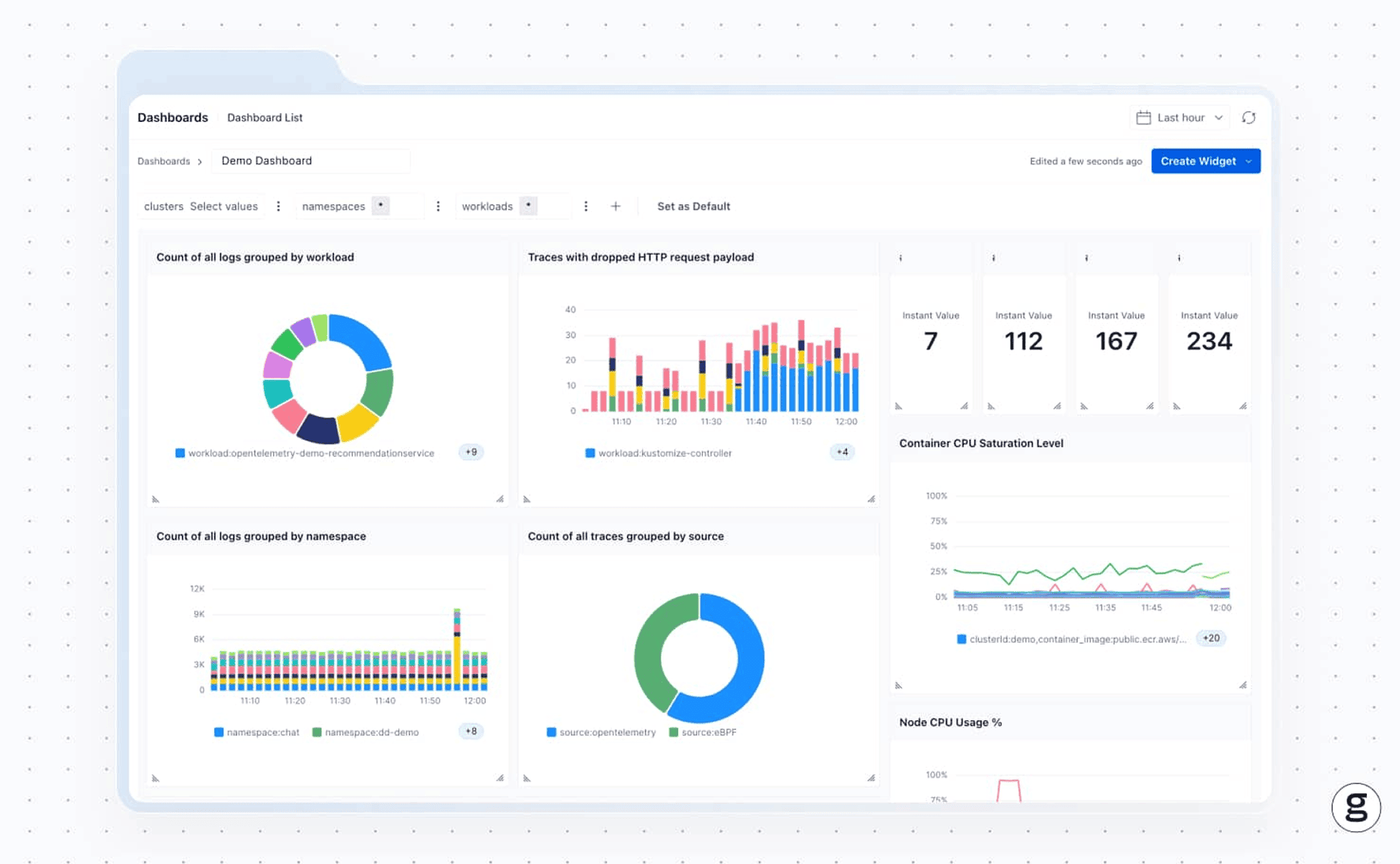
That’s where groundcover comes in. By comprehensively tracing network data flows across all layers of your cluster, groundcover delivers the deep visibility you need to determine where data is moving and which resources or traffic patterns are triggering high transfer costs. Leveraging this visibility, you can make informed decisions to optimize Kubernetes data transfer spending.
Saying goodbye to unnecessary data transfer costs in Kubernetes
You’ll face some data transfer fees for most cloud-based Kubernetes clusters, but you need not pay a fortune. With the right architectural decisions and tools on your side, you can take full advantage of high-availability Kubernetes setups without also paying unreasonably high Kubernetes data transfer fees.
FAQs
To monitor transfer costs across clusters in a generic way, engineers can use cloud service providers’ cost reporting tools, such as AWS Cost Explorer. For more detailed and real-time data, Kubernetes cost monitoring software, like Kubecost or OpenCost, is the best type of solution.
Maintaining a balance between performance and cost requires strategic analysis of which levels of reliability and performance the business requires, as well as what it’s willing to pay to achieve them. For mission-critical applications, it may make sense to host Pods in multiple AZs or cloud regions as a way of maximizing availability, even if this also leads to high data transfer fees. For less important workloads, the organization might prioritize cost savings over performance and availability.
Groundover provides deep visibility into network traffic flows within Kubernetes, as well as traffic moving from a cluster to external endpoints. Using this insight, engineering teams can pinpoint which patterns are causing the highest amount of data transfers between cloud AZs, regions, or platforms. In turn, they can make changes (such as repositioning workloads or enabling caching) to reduce egress rates.