Secret Rotation: How It Works, Challenges & Best Practices



Imagine that you’re leasing an apartment whose locks have never been changed since the time the first tenant moved in years ago. Chances are that you wouldn’t sleep well at night knowing that everyone who has lived there before could have a copy of the key that opens your door. This is a bit like what happens to software security when organizations fail to implement secret rotation - meaning the practice of changing passwords, access codes, and other secret data regularly. This is precisely why secret rotation is such an important part of software security. By replacing secrets as often as practical, you can substantially reduce your vulnerability to attack.
Read on for details as we explain how secret rotation works, why it’s important, how to implement it, and best practices for establishing a highly effective secret rotation strategy.
What is secret rotation, and why does it matter for security?
Secret rotation is the practice of automatically updating passwords, API keys, certificates, tokens, and other access credentials within software systems. When you rotate secrets, you replace the secret value of an older access credential with a newer one.
Secret rotation is valuable as a security enhancement measure because it ensures that anyone who had access to a secret in its original form will no longer be able to use it to log in. This helps protect against two specific types of threats:
- External threat actors, who may have compromised credentials through measures such as breaching a password database.
- Malicious insiders, like former employees who received access credentials for legitimate purposes at one point, but should no longer be able to use them to log in.
Secret rotation frequency can vary widely. Often, organizations adopt rotation intervals that update secrets only periodically, such as once every several months. But more robust - and more secure - secrets rotation involves updating credentials more often. For example, one approach is to allow each secret to be used to log into a system just one time, then automatically update it.
Secret rotation vs. secret expiry and manual credential updates
Secret rotation is not the only way of updating access credentials. Related practices include:
- Secret expiry, which invalidates an existing access credential but (unlike secret rotation) doesn’t automatically replace it with a new value.
- Manual updates, which require users to reset passwords and other credentials manually. The difference between manual updates and secret rotation is that the latter is a fully automatic process that doesn’t depend on manual participation by human users to ensure that credentials are secure.
How secret rotation works
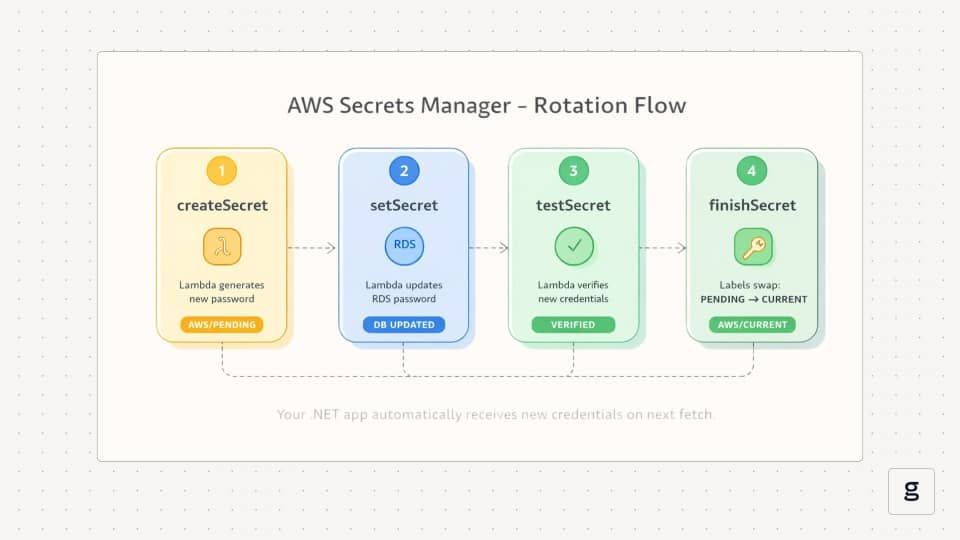
The secret rotation process works based on the following key steps:
- Creation of rotation conditions: Admins configure rules that determine when a secret should be rotated. The conditions could be simple factors like how long a secret has been active, or they could be more complex, such as how many times a secret has been used to log in, or the sensitivity level of the system that the secret accesses.
- Old secret revocation: When the rotation conditions for a secret are met, the secret is automatically invalidated.
- New secret generation: A new secret is automatically generated to replace the old one.
- New secret validation: After generation, the new secret is tested to ensure it works properly.
- New secret application: Systems that rely on the secret are automatically updated to use the new value.
As you can see - and as we mentioned previously - these are processes that take place automatically, without relying on human users to update secrets by hand. Automatic rotation is key because it ensures that the process can happen consistently and without the risk that human oversight or poor decisions (like replacing a password with a new one that is virtually identical to the original secret value) will undercut the impact of secret rotation.
Secret rotation in Kubernetes and microservices architectures
You can use secret rotation in virtually any type of software system. But the more complex the system, the more challenging it is to implement.
In particular, secret rotation tends to be complicated in distributed, microservices-centric systems like Kubernetes. This is mainly because multiple components are involved in the management of secrets. For example, in Kubernetes secret management, you’d typically create secrets using kubectl, store them in a secret manager, and expose them to applications through techniques like mounting a volume that contains the secret data. This can all be done, but it’s more complicated than secret rotation in a simple, monolithic system where the secret is stored and managed directly within the application that uses it.
Types of secrets that require rotation
Secrets come in many forms, and virtually all types should be rotated. Common types of secrets that organizations rotate include:
- Passwords: Passwords that grant human or machine users access to a system should be changed at least periodically.
- API keys: API keys, which applications use to authenticate with each other and with external services, are most secure when they are subject to rotation.
- SSH keys: SSH keys allow users to log into servers remotely. Rotation reduces the risk that attackers will be able to access systems using keys that they managed to obtain.
- Encryption keys: Keys that encrypt data, too, should be cycled so that only those who have received access to the encryption key recently will be able to use it to unlock sensitive information.
These are just examples of key types of secrets to rotate. In most cases, it’s best practice to rotate secrets of all types. The only real exception is secrets for legacy systems that are difficult or impossible to update.
Benefits of automated secret rotation for security and compliance
From a security perspective, the main benefit of secret rotation is that it reduces the period during which a leaked credential (or one that is accessible to a malicious insider) can be used to carry out an attack. Secret rotation doesn’t guarantee that bad actors won’t take advantage of secrets to do bad things, but it makes it harder by preventing them from abusing compromised secrets beyond the rotation period that an organization uses.
Secret rotation can also be beneficial from a compliance perspective. While major compliance regulations don’t usually explicitly require secret rotation, various cybersecurity frameworks do require organizations to take reasonable measures to prevent unauthorized access to their IT systems. Secret rotation is a great step toward that goal - so by rotating secrets, organizations place themselves in a stronger position to demonstrate compliance with key cybersecurity requirements.
Common challenges in implementing secret rotation at scale
While secret rotation is important, it’s also challenging to implement, especially for large organizations that have hundreds or thousands of secrets spread across disparate systems. The main issue here is sheer scale: With so many secrets, and so many different use cases for those secrets, it can be tough to establish centralized control over when and how secrets are rotated.
Tools and solutions for secret rotation
But challenging doesn’t mean impossible. With the right tools and solutions, it’s possible to automate secret rotation at virtually any scale.
The best type of tool to use for scalable secret rotation is a secret management solution, such as HashiCorp Vault or StrongDM (to name just a couple of examples). Most modern secrets managers include capabilities for enforcing automated rotation of secrets stored within them. Admins simply configure when and how secret rotation should take place, and the secrets manager performs it automatically.
What’s more, you can integrate these secret managers with platforms like Kubernetes to rotate secrets automatically across the entire platform. Thus, even if you have numerous secrets associated with various Pods, nodes, and so on across your Kubernetes cluster, a secret manager can automatically rotate all of them from a centralized location.
Another approach for implementing secret rotation is to write custom scripts. For example, in Kubernetes, you could script kubectl commands to rotate secrets periodically. But that strategy would be tough to scale because you’d have to deploy custom scripts for each of your secrets. It would also create a burden for developers because they’d have to maintain the rotation scripts and update them whenever your workload configurations change.
Best practices for reliable and secure secret rotation
To rotate secrets as efficiently and securely as possible, consider the following best practices:
- Use a secret manager: As we just explained, the most scalable way to automate secret rotation is via a dedicated secret management tool. This approach is also more secure because it comes with the benefit of storing all of your secrets in a central location.
- Rotate as frequently as possible: In general, the more often you rotate secrets, the better. The only common reason not to maximize rotation frequency is if doing so would require manual effort on the part of users to update or deploy new secrets - but if you automate all aspects of the process, this shouldn’t be an issue.
- Validate new secrets: There’s always a chance that new secrets won’t work properly for various reasons. For instance, a newly automatically generated secret might violate the structural requirements of an application. To safeguard against this risk, it’s best practice to test secrets automatically to ensure that they are usable before the rotation process is complete. If a secret fails automated testing, your secret rotation tool should deploy a new secret to replace it.
- Delete old secrets: A common mistake during secret rotation is updating secrets but keeping the old credentials on hand. This is a poor practice because there is a risk that bad actors could use outdated secrets by, for example, deploying an older version of an application that is still configured to use an older version of a secret. Mitigate this risk by permanently deleting old secrets once they have been replaced, unless you have a specific reason to keep them on hand.
Monitoring and detecting failures during secret rotation
As we said, secret rotation doesn’t always go as planned - and the fact that it’s automated can make it all the more risky, in the respect that failures may go undetected until they cause an actual problem.
This is why it’s important to monitor for failures during the rotation process. Issues to check for include:
- Failure to trigger secret rotation: Admins usually specify a secret’s rotation settings, which determine when rotation takes place. But due to configuration oversights or bugs in secret managers, rotation events may not trigger when they should.
- Newly generated secrets that are malformed or empty: This could result from bugs in secret generation tools or mismatches between the secret format used by a secret generator and an application or service (for instance, a generator might produce an SSH key that is shorter in length than the one required by a server).
- Failures in applying new secrets: Configuration errors or broken network connections may cause failures when updating an application or service to point to a new secret.
- Failure to delete old secrets: Even if you configure secret rotation tools to delete outdated secrets automatically, this may not always happen due to issues like storing them on a read-only file system.
Catching issues like these requires continuous visibility into secret rotation activity. Secrets should be tested and validated, and errors should result in alerts so that admins can take action. You don’t want to wait until an application fails or a service goes down to realize that something went wrong with your secret rotation process, causing a failure due to a missing or broken secret.
Observability-driven secret rotation visibility with groundcover
Detecting secrets issues is where observability tools like groundcover come in. By continuously monitoring everything happening within software environments - including complex, distributed platforms like Kubernetes - groundcover can instantly detect problems that stem from failed secret rotation, such as connection issues between applications or services.
With this insight, admins can get ahead of secret issues and take action to correct them before they cause a serious disruption.
The best secrets are temporary
The less time you keep secrets on hand, the better - which is why secret rotation is a powerful way to reduce risk. But rotating secrets is only effective if it’s an automated, reliable process. To ensure that rotation doesn’t create more problems than it solves, it’s critical to observe the rotation process, detect problems, and correct them before they lead to failures.
FAQ
How often should secrets be rotated in cloud-native environments?
The best way to rotate secrets in most cloud-native environments is via a secret manager. Secret managers store secrets centrally and can automatically enforce rotation policies. The ability to centralize this process is especially beneficial in cloud-native environments, whose complex and distributed nature makes manual rotation very challenging.
What are the most common causes of downtime during secret rotation?
The main cause of downtime during secret rotation is missing or failed automation. If someone has to sign off manually on the provisioning of a new secret, there is a risk that it won’t be deployed quickly enough, causing applications or services to fail if they’re still trying to use an older secret that has been revoked. Bugs with secret rotation tools may also cause this problem in the event that they result in updated secrets not being deployed properly.
How does groundcover help teams detect and troubleshoot secret rotation failures in production?
The observability features in groundcover help teams detect application and service failures quickly. Since failed secret updates are one cause of such failures, the insights that groundcover delivers help to detect secrets issues in production. What’s more, groundcover delivers the comprehensive context teams need to make informed inferences about whether an application or service failure is the result of a secret problem or another type of issue.